When selecting laser marking vs laser engraving, always prioritize the laser source brand (JPT/Raycus) over raw wattage for long-term reliability.
Laser Marking Vs Laser Engraving: OEM & Customization
Customization Capabilities for Industrial Laser Systems
At Klear Laser, we engineer customized solutions for diverse industrial requirements. Our engineering team collaborates directly with manufacturers to develop specialized configurations.
Customized Chassis Designs
Klear Laser fabricates precision chassis engineered for specific production environments. Sealed beam paths with integrated filtration systems prevent contamination in harsh environments. We offer modular mounting systems that adapt to production lines or standalone operation. Customized enclosures with safety interlocks meet global industrial standards.
Softwareanpassung
Our marking and engraving systems feature intuitive interfaces that operators can adapt. Software development kits allow integration with existing manufacturing systems. Key software capabilities include:
Intuitive interfaces enabling operators to adjust parameters with minimal training
API integration connecting directly with existing manufacturing systems
Vision recognition systems that automatically locate and mark irregular surfaces
Recipe management that stores thousands of approved parameter sets for consistent quality
Security protocols that protect proprietary product information
Anpassung der Laserleistung
We offer configurable laser sources for material-specific applications. Fiber laser sources deliver 20W to 300W for production environments. UV lasers offer 5W to 35W for delicate applications. Power modulation adjusts during the process to accommodate material variations. Pulsed outputs provide controlled heat input for sensitive components. Multi-wavelength systems combine laser types for complex material processing. Water-cooled or air-cooled options ensure optimal efficiency in diverse factory conditions. Energy consumption monitoring reduces operating costs.
| Spezifikation | Traditional Marking | Laser Marking | Laser Engraving |
|---|---|---|---|
| Material Removal | Yes (ink, labels) | No – surface modification only | Yes – controlled material vaporization |
| Surface Impact | High stress, damage | Minimal stress, clean | Moderate stress, controlled |
| Depth Capability | Surface to 0.1mm | 0.001-0.01mm | 0.01-5mm |
| Production Speed | 1-10 units/min | 10-70 units/min | 1-20 units/min |
| Auswirkungen auf die Umwelt | Chemical waste, emissions | Low energy, no consumables | Particulate waste, requires filtration |
Klear Laser’s application engineers analyze specific production requirements to recommend optimal configurations. We prototype solutions that demonstrate precise depth control, substrates, and integration capabilities. Our customization approach ensures consistent quality across high-volume production runs.
Hauptmerkmale und Vorteile
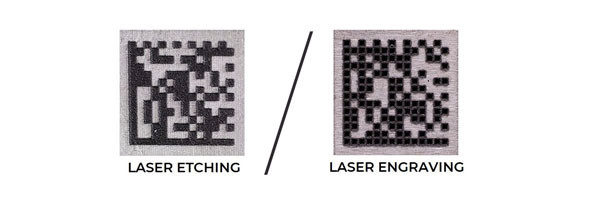
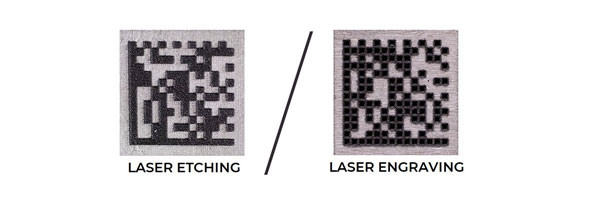
Klear Laser distinguishes laser marking from laser engraving through precision engineering and high-performance components. Laser marking alters the surface of a material with minimal penetration, ideal for barcodes, serial numbers, and UID tags. It uses a fiber laser source, typically from JPT or Raycus, known for long life and stable output. The MOPA (Master Oscillator Power Amplifier) configuration allows fine control over pulse duration, enabling high-contrast marks on sensitive materials without substrate damage.
Laser engraving, in contrast, involves material removal to create deep, tactile marks. Klear Laser’s engraving systems use high peak power pulsed fiber lasers with extended pulse widths, enabling aggressive ablation while maintaining edge precision. The integration of dynamic scanning heads with high-speed galvanometers ensures consistent depth control across complex geometries. These systems are built for industrial durability, with sealed optical paths and air-assist nozzles to prevent debris accumulation.
The core advantage lies in the modular design of the laser source and scanning head. Users can switch between marking and engraving by adjusting pulse parameters or upgrading to a high-power source. Klear Laser uses only Tier-1 components—JPT MOPA lasers for marking, Raycus pulsed sources for deep engraving—paired with Cambridge or Synrad galvo heads for unmatched beam quality.
| Merkmal | Laser Marking (Klear M-Series) | Laser Engraving (Klear E-Series) |
|---|---|---|
| Laser-Quelle | JPT MOPA Fiber, 20–60W | Raycus Pulsed Fiber, 60–100W |
| Impulsbreitenbereich | 2–200 ns (adjustable) | 100–300 ns (deep ablation optimized) |
| Scan-Kopf | Cambridge 3D Galvo, 140mm lens | Synrad High-Torque Galvo, 200mm lens |
| Marking/Engraving Depth | 0.01–0.1 mm (surface modulation) | 0.1–1.0 mm (material removal) |
| Applications | Serial numbers, data matrix, logos | Nameplates, molds, deep logos |
| Kompatibilität der Substrate | Metals, anodized aluminum, plastics | Steel, titanium, carbide, composites |
This component-level optimization ensures that Klear Laser systems exceed industry standards in speed, repeatability, and maintenance intervals. Whether marking surgical tools or engraving aerospace components, the integration of premium sources and heads delivers superior contrast, edge sharpness, and operational efficiency.
Industrielle Anwendungen
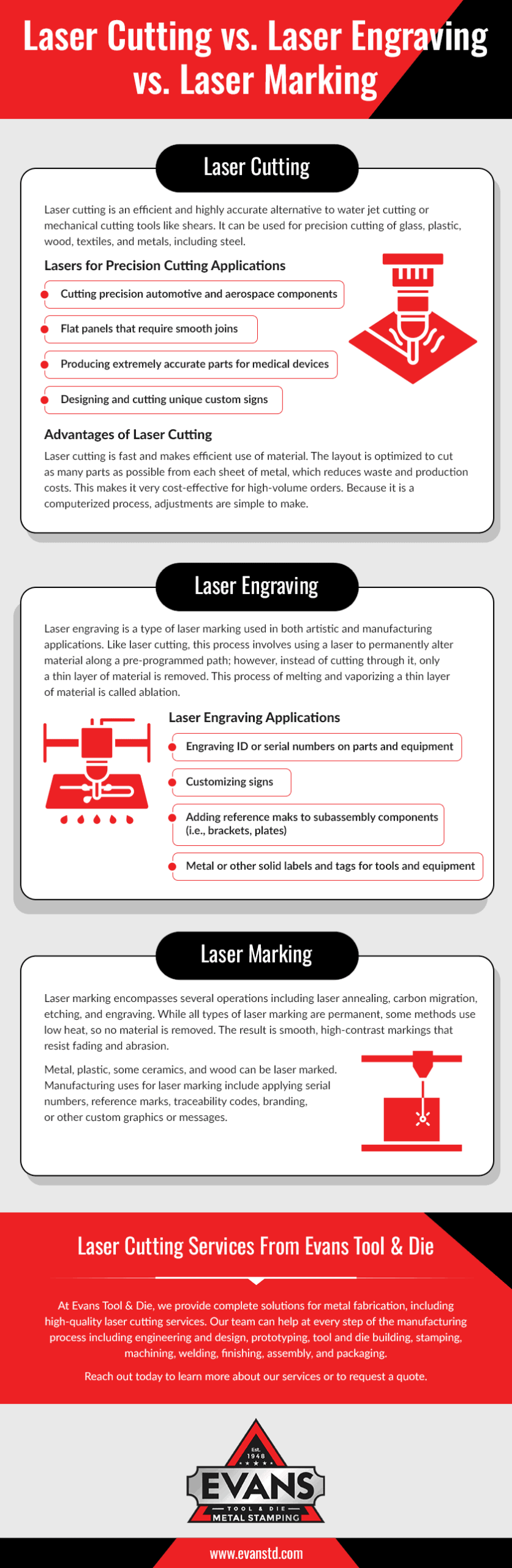
Laser marking and engraving serve distinct industrial purposes. Marking modifies surfaces without material removal, creating permanent identifiers. Engraving physically removes material to create deeper, tactile marks. Each process is chosen based on industry-specific durability and compliance needs.
In automotive manufacturing, laser marking is used for VIN plates and engine component traceability. It ensures tamper-resistant, corrosion-resistant labels without weakening structural elements. Engraving is limited to non-critical parts like trim pieces where deeper tactile IDs are required.
Aerospace applications demand extreme precision to meet safety regulations. Laser marking on titanium and aluminum alloys preserves structural integrity for flight-critical parts. Engraving is strictly avoided on high-stress components to prevent stress concentrations and material fatigue.
Marine environments require saltwater-resistant identifiers on stainless steel and aluminum hull fittings. Laser marking provides smooth, defect-free IDs that resist corrosion initiation. Engraving is prohibited on submerged components to avoid crevice corrosion risks from surface imperfections.
| Material | Laser Marking Applications | Laser Engraving Applications |
|---|---|---|
| Rostfreier Stahl | Permanent VIN, serial numbers, compliance tags | Deep part numbers and nameplates for durability |
| Aluminum | Surface color change for safety-critical parts | Non-critical components with controlled depth |
| Titan | Non-destructive traceability for aerospace parts | Limited to non-structural areas only |
| Plastics | Minimal surface alteration without melting | Decorative or functional deeper engravings |
| Verbundwerkstoffe | Non-destructive aircraft component marking | Rarely used due to delamination risks |
Warum Klear Laser wählen
Klear Laser’s value proposition begins with lifetime process support. From the first sample weld to full-scale production, our application engineers stay on call to dial-in penetration depth, cleaning parameters, or UV-cure profiles. You receive the cell-phone numbers of the same technicians who built and calibrated your system, so answers arrive in minutes, not days.
Every machine ships with a comprehensive 3-year bumper-to-bumper warranty that covers the JPT or Raycus laser source, scan head, and motion chassis. Unlike regional brokers who disappear after the PO, we keep a ledger of your unit’s serial numbers and maintain replacement inventory in both California and Frankfurt. If a pulsed-cleaning board or wobble-weld head ever hiccups, we air-ship the spare and walk you through hot-swap installation over live video.
Spare-parts availability is guaranteed for a minimum of ten years. Fiber laser sources, F-theta lenses, and UV LED bars are stocked at 30 % above forecast demand, so even obsolete models stay supported. Standard consumables—protective windows, nozzles, and bellows—ship within 24 h; critical components like Q-switch drivers or weld monitoring cards ship within 72 h anywhere on the planet.
| Support Element | Klear Laser Versprechen | Industry Norm |
|---|---|---|
| Process Support | Lifetime, direct engineer hotline | 6–12 months, ticket portal |
| Dauer der Garantie | 3 years, source to chassis | 1 year, source only |
| Spare-Parts Stock | 30 % buffer, 10-year availability | 2–3 years, limited SKUs |
| Replacement Lead Time | 24–72 h global air-ship | 2–6 weeks sea freight |
💰 ROI Calculator: Laser Marking Vs Laser Engraving
Sind Sie bereit für ein Upgrade Ihrer Produktion?
Kontaktieren Sie Klear Laser für professionelle industrielle Lösungen.