When selecting laserschweißmaschine, always prioritize the laser source brand (JPT/Raycus) over raw wattage for long-term reliability.
Laserschweißmaschine: Technical Specifications
A laserschweißmaschine represents a fundamental shift in industrial joining technology. These systems utilize high-power fiber laser sources to deliver concentrated energy density for precision welding applications. Wavelength selection, pulse energy control, and thermal management determine the machine’s capability across automotive, aerospace, and heavy fabrication sectors. Understanding these parameters is essential for process engineers specifying equipment for production lines.
Fiber laser welding systems operate at a 1064 nanometer wavelength, placing them in the near-infrared spectrum. This wavelength achieves excellent absorption in ferrous metals, stainless steel, and most aluminum alloys used in industrial manufacturing. Copper and gold reflect significant energy at 1064nm, requiring higher power densities or alternative wavelengths like 450nm blue lasers for efficient coupling. The monochromatic nature ensures consistent material interaction throughout the beam path.
The 1064nm wavelength transmits efficiently through standard optical fibers and delivery optics with minimal losses. This enables flexible beam delivery to robotic welding cells and fixed workstations alike. Beam delivery systems maintain polarization stability and mode quality over distances exceeding 50 meters in factory environments. Optical components require anti-reflective coatings specifically optimized for this wavelength to prevent thermal lensing effects.
Pulse energy directly controls penetration depth and weld pool dynamics in pulsed laser welding applications. Typical industrial systems deliver 30 to 100 joules per pulse for thin-gauge materials up to 3mm thickness. Peak power density can exceed 10^6 W/cm² during nanosecond pulse durations, enabling keyhole formation in reflective materials. Continuous wave (CW) operation for deep penetration welding requires sustained power delivery from 1kW to 6kW average power.
Pulse width modulation affects the heat-affected zone (HAZ) and solidification cracking susceptibility in crack-sensitive alloys. Shorter pulses (1-10ms) minimize thermal diffusion into surrounding material, reducing distortion in precision components. Longer pulses or CW operation increase penetration but require careful fixture design to manage heat buildup. The transition from pulsed to CW mode allows a single machine to handle both seam welding and deep penetration applications.
Thermal management maintains resonator stability and prevents diode degradation in high-power laser sources. Precision chillers deliver temperature-controlled coolant at ±0.5°C stability to the laser head and source. Water-cooled systems dissipate up to 30kW of waste heat from a 6kW laser source, maintaining diode junction temperatures below 25°C. Closed-loop chillers with deionized water prevent scaling and corrosion in micro-channel coolers.
Chiller capacity scales linearly with laser power, requiring 5-6kW of cooling capacity per 1kW of laser output. Ambient operating temperature ranges from 5°C to 45°C for industrial-grade systems. Flow sensors and temperature interlocks provide immediate shutdown protection if cooling fails. Proper maintenance includes quarterly filter changes and annual conductivity testing to ensure heat exchanger efficiency.
JPT and Raycus fiber laser sources integrate these parameters into industrial-grade packages with proven field reliability. Wobble welding heads dynamically oscillate the beam up to 4mm amplitude to increase weld width and improve gap tolerance. This beam oscillation compensates for joint fit-up variations while maintaining precise control over penetration depth. The combination enables single-pass welding of dissimilar thickness combinations with minimal filler material.
| Parameter | Traditionelles MIG/TIG-Schweißen | Klear Laser Laserschweißmaschine |
|---|---|---|
| Wärmezufuhr | 60-150 J/mm, high distortion | 15-40 J/mm, minimal distortion |
| Eindringtiefe | 3-8mm with multiple passes | Up to 10mm in single pass at 6kW |
| Geschwindigkeit beim Schweißen | 0.3-1.2 meters/minute | 2-8 meters/minute depending on thickness |
| Joint Gap Tolerance | Requires <0.5mm fit-up precision | Tolerates up to 1.2mm with wobble head |
| Material Distortion | 2-5mm warpage common | <0.5mm typical on 3mm stainless steel |
| Power Efficiency | 30-40% at the arc | 45-50% wall-plug efficiency |
| Post-Weld Processing | Grinding and cleanup required | Clean welds, minimal spatter |
| Betriebskosten | $8-15/hour consumables | $3-6/hour electrical and gas |
Industrial manufacturers achieve ROI within 18-24 months through reduced consumables and increased throughput. The laserschweißmaschine eliminates electrode grinding, wire feeding systems, and shielding gas waste associated with conventional processes. Automotive body-in-white applications demonstrate 70% faster cycle times on galvanized steel joints with zero burn-through defects. This technology fundamentally redefines manufacturing economics while delivering superior metallurgical properties.
Hauptmerkmale und Vorteile
The Klear Laser laserschweißmaschine leverages premium core components to deliver unmatched welding performance. Its heart is a high-power JPT or Raycus fiber laser source, renowned for exceptional beam quality (M² < 1.2) and stable output. This ensures deep, consistent penetration and a superior weld seam quality, even in demanding applications like thick stainless steel or aluminum joining. The integrated wobble welding head provides dynamic beam oscillation, significantly enhancing weld pool control and reducing spatter.
This combination enables precise control over penetration depth and width, crucial for high-integrity industrial welds. The wobble function also allows superior gap bridging tolerance and reduced heat input, minimizing thermal distortion. These features make Klear Laser welders ideal for aerospace, automotive, and heavy equipment manufacturing where accuracy and reliability are critical.
Key Component Specifications:
| Merkmal | Klear Laser Laserschweißmaschine | Standard Industry Average |
|---|---|---|
| Laser-Quelle | JPT/Raycus Fiber Laser | Generic Fiber Laser |
| Strahlqualität (M²) | < 1,2 | < 1.5 |
| Maximale Durchdringung | Up to 25mm (Dependent on material & power) | Typically 10-15mm |
| Taumelschweißkopf | Yes (Programmable amplitude/frequency) | Rarely Offered |
| Spitzenleistungsstabilität | ±2% | ±5% |
| Sicherheit des Substrats | Minimal HAZ due to precise energy control | HAZ often more pronounced |
Industrielle Anwendungen
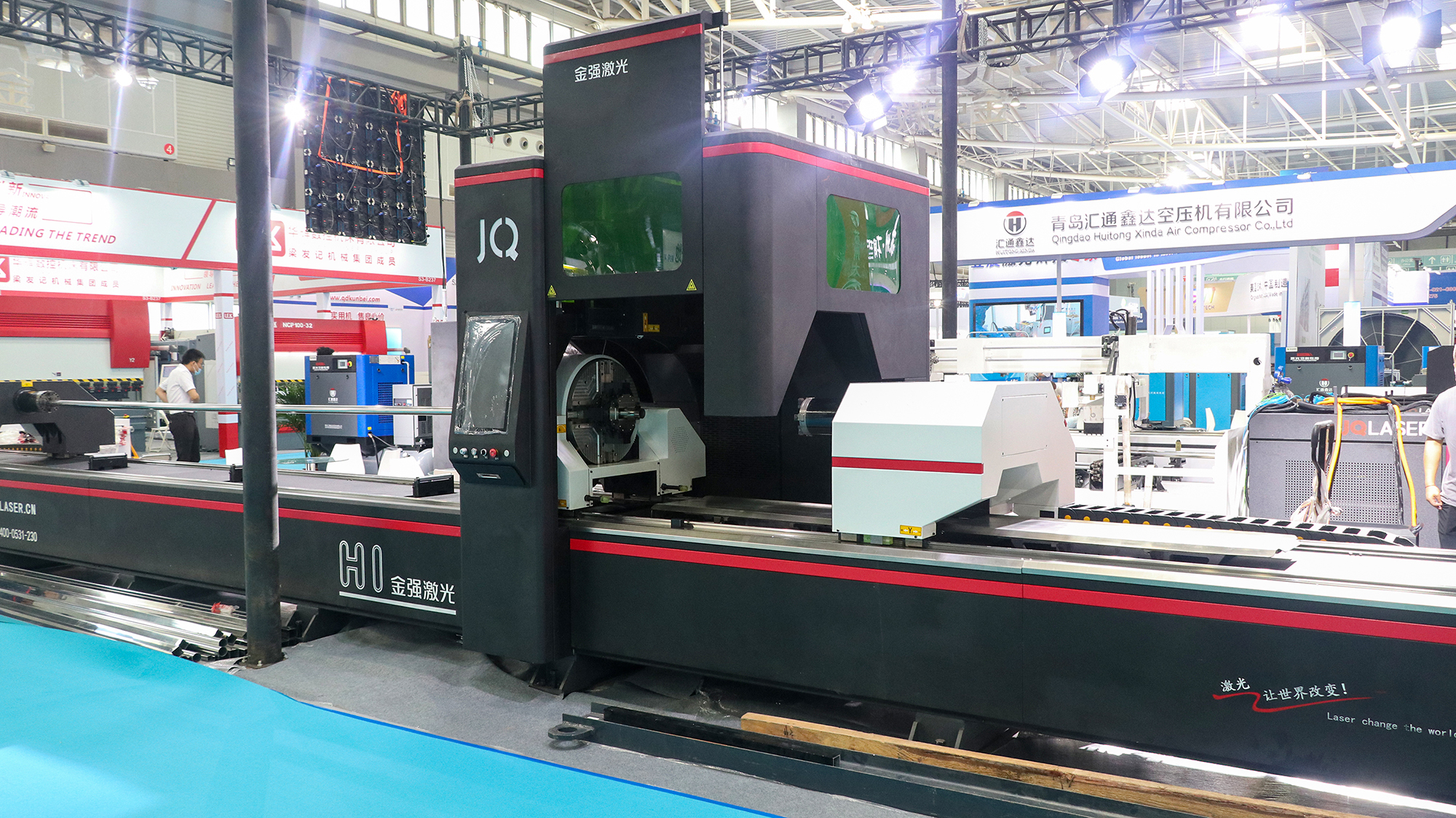
Laser welding machines are widely used in the automotive industry for precision joining of high-strength steels and aluminum alloys. Applications include battery tab welding in electric vehicles, transmission components, and structural parts where deep penetration and minimal heat input are critical. The use of high-power fiber lasers with JPT or Raycus sources ensures consistent weld quality and high throughput.
In aerospace, laser welding is employed for turbine engine components, fuselage panels, and heat-resistant alloy assemblies. The process enables lightweight designs and supports the use of advanced materials like titanium and Inconel. Wobble welding heads are often integrated to improve gap bridging and reduce porosity in critical joints.
Marine engineering benefits from laser welding in the fabrication of propulsion systems, piping, and pressure vessels. Corrosion-resistant alloys are commonly welded using pulsed fiber lasers to maintain material integrity in harsh environments. The precision of laser welding reduces distortion, which is crucial for large-scale shipbuilding components.
| Material | Applicable Industry | Typischer Dickenbereich | Key Laser Parameter Advantage |
|---|---|---|---|
| Weichstahl | Automobilindustrie, Marine | 0.5 – 8 mm | High speed, low spatter |
| Aluminium-Legierungen | Automobilindustrie, Luft- und Raumfahrt | 1 – 6 mm | Deep penetration, low heat input |
| Rostfreier Stahl | Marine, Automotive | 0.8 – 10 mm | Excellent seam quality |
| Titanium (Ti-6Al-4V) | Luft- und Raumfahrt | 1 – 5 mm | Minimal oxidation, high precision |
| Inconel 718 | Luft- und Raumfahrt | 0.8 – 4 mm | Crack-resistant welds, stable melt pool |
Warum Klear Laser wählen
Klear Laser provides 24/7 technical support with a 4-hour response guarantee. Remote diagnostics and on-site expert assistance minimize production interruptions. Engineers are trained to resolve complex welding system issues efficiently for continuous operations.
All Klear fiber laser welders include a standard 2-year warranty covering core components like JPT and Raycus sources and wobble welding heads. Extended warranty options up to 5 years are available for critical parts. This ensures long-term reliability and reduces total ownership costs.
Klear maintains a global inventory with 95% of parts in stock for immediate shipment. Most spare parts are delivered within 24 hours globally to avoid downtime. Genuine components ensure perfect compatibility and optimal system performance.
| Aspekt | Einzelheiten |
|---|---|
| Unterstützung | 24/7 technical support with 4-hour response; remote and on-site experts |
| Garantie | 2-year standard coverage on core components; extendable to 5 years |
| Ersatzteile | 95% global inventory; 24-hour delivery; genuine parts guaranteed |
💰 ROI Calculator: Laserschweißmaschine
Sind Sie bereit für ein Upgrade Ihrer Produktion?
Kontaktieren Sie Klear Laser für professionelle industrielle Lösungen.