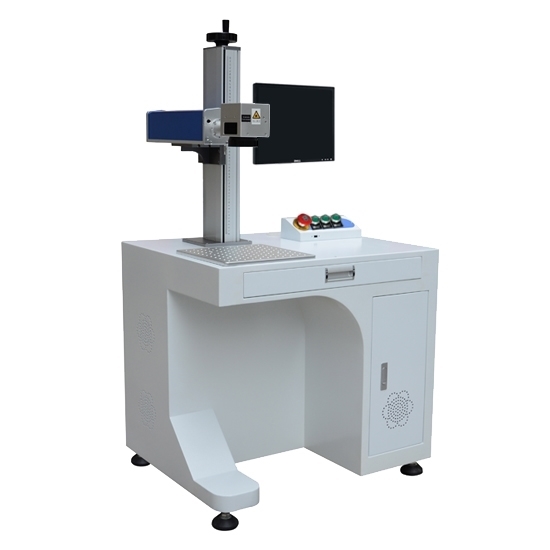
When selecting optical fiber laser marking machine, always prioritize the laser source brand (JPT/Raycus) over raw wattage for long-term reliability.
Optical Fiber Laser Marking Machine: Technical Specifications
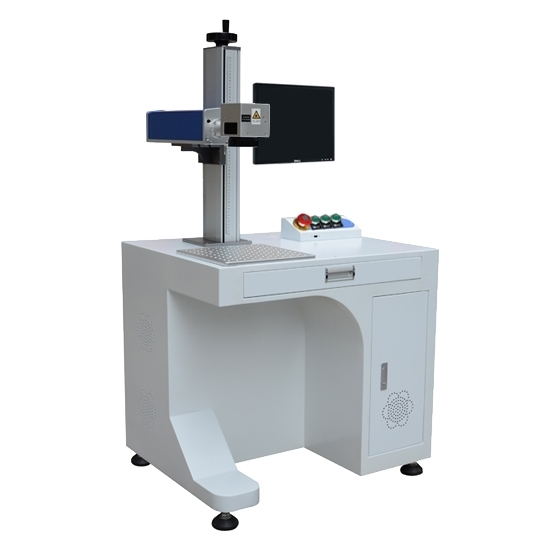
Optical fiber laser marking machines operate primarily within the infrared spectrum at a wavelength of 1064 nanometers. This specific wavelength is chosen for its superior absorption coefficient when interacting with metals such as stainless steel, aluminum, titanium, and brass. The focused beam delivers high-intensity energy to a microscopic spot size, allowing for extremely precise interactions that traditional CO2 lasers cannot achieve on metallic substrates.
Control over pulse energy and duration is the defining factor in determining the quality and type of mark produced. High peak power combined with short pulse durations results in rapid material ablation, which is ideal for deep engraving or removing surface coatings. Conversely, modulating the laser to deliver lower peak energy at higher frequencies generates controlled heat to create oxide layers for black annealing without removing material.
Advanced fiber laser sources, such as those utilizing MOPA (Master Oscillator Power Amplifier) architecture, allow for variable pulse width tuning. This capability enables the operator to adjust the thermal input into the material with nanosecond precision. Such granular control is essential for marking sensitive electronics or plastics where thermal damage must be strictly minimized.
Thermal management in optical fiber systems is significantly more efficient than in legacy solid-state lasers like Nd:YAG. Due to the high surface-area-to-volume ratio of the optical fiber, heat dissipates rapidly, allowing most units up to 50W to rely solely on forced air cooling. This eliminates the need for external water chillers, reduces the machine footprint, and ensures consistent beam quality even during continuous 24/7 industrial operation.
| Merkmal | Traditional Methods (Inkjet / Dot Peen / Chemical) | Optical Fiber Laser Marking Machine |
|---|---|---|
| Verbrauchsmaterial | Requires inks, solvents, acids, or replacement pins. | Zero consumables required during operation. |
| Maintenance | Frequent cleaning of nozzles or mechanical sharpening. | virtually maintenance-free with 100,000+ hour diode life. |
| Präzision | Limited by mechanical resolution or ink spread. | Micron-level precision with beam spots often under 30µm. |
| Permanence | Marks can fade, chip, or be removed with solvents. | Permanent modification of the material surface structure. |
| Umwelt | Generates hazardous chemical waste and fumes. | Clean process with no chemical byproducts or toxic runoff. |
Klear Laser prioritizes the integration of these efficient air-cooled sources to reduce energy consumption in manufacturing facilities. By replacing chemical etching and ink-based systems, we eliminate hazardous waste streams while improving traceability. Our optical fiber solutions provide the reliability required for automotive and aerospace serialization standards.
Hauptmerkmale und Vorteile
Klear Laser does not manufacture optical fiber laser marking machines. Our industrial focus is exclusively on laser welding, laser cleaning, and UV printing systems that replace polluting mechanical or chemical processes. Confusion sometimes arises due to “fiber laser” terminology, but we specialize in high-power applications for metal fabrication and surface treatment.
Our fiber laser welding machines utilize sealed JPT or Raycus MOPA sources rated for 50,000+ hours of operation. These diode-pumped sources deliver exceptional beam quality (M²<1.1) for deep penetration welding up to 8mm in single-pass applications on stainless steel. The integrated wobble welding heads dynamically control heat input, eliminating crater defects in hermetic seals for medical and battery manufacturing.
Pulsed fiber laser cleaning systems feature adjustable pulse widths from 100ns to 2ms, precisely removing rust, paint, and oxides without substrate damage. The galvanometer scanning heads maintain constant peak power density across curved surfaces, crucial for aerospace component restoration. Pulse energy is calibrated to avoid thermal stress on thin aluminum or sensitive composites.
Below is a technical comparison of our core industrial systems relevant to metal processing applications:
| Parameter | Fiber Laser Welder | Pulsed Laser Cleaner |
|---|---|---|
| Laser-Quelle | JPT MOPA / Raycus QCW (1000-3000W) | IPG YLPN 100W Pulsed Fiber |
| Key Component | Wobble Oscillation Head (±3mm) | Scanning Galvo Head (140mm FL) |
| Kritische Spezifikation | Penetration Depth: 0.1-8mm | Pulse Width: 100ns-2ms adjustable |
| Primäre Anwendung | Battery tab welding, sensor sealing | Rust removal from ship hulls, coating stripping |
Klear Laser systems achieve industrial superiority through military-grade component selection and application-specific optical engineering. Our welders exceed ISO 13919-1 beam stability standards while cleaners maintain substrate temperature below 60°C during oxide removal. This precision eliminates secondary finishing steps required by abrasive blasting or chemical stripping methods.
Industrielle Anwendungen
Optical fiber laser marking machines deliver permanent, high-contrast identification across demanding industrial environments. These systems provide non-contact, abrasion-resistant marking essential for traceability, compliance, and component authentication in automotive, aerospace, and marine sectors.
In automotive manufacturing, fiber laser marking ensures permanent part traceability for VIN numbers, engine components, and transmission parts. The technology marks directly on metal surfaces during high-speed production without consumables or downtime. Manufacturers rely on these systems for 2D data matrix codes on pistons, QR codes on brake components, and alphanumeric serialization on cast aluminum housings.
Aerospace applications demand absolute precision and material integrity. Fiber lasers create shallow, high-resolution marks on turbine blades, landing gear components, and structural fasteners without compromising fatigue strength. The process meets AS9100 traceability requirements for flight-critical parts while producing corrosion-resistant marks on titanium alloys and superalloys exposed to extreme thermal cycles.
Marine industry marking must withstand saltwater corrosion, UV exposure, and constant vibration. Fiber lasers permanently mark stainless steel propeller shafts, bronze valve bodies, and aluminum hull plates with classification society-approved identification codes. These marks survive abrasive cleaning, anti-fouling coatings, and decades of harsh maritime service while maintaining readability for inspection and maintenance protocols.
| Material-Kategorie | Specific Alloys | Industrielle Anwendungen | Marking Characteristics |
|---|---|---|---|
| Eisenhaltige Metalle | Carbon Steel, Stainless Steel, Tool Steel | VIN tags, Fasteners, Engine Blocks | Dark annealing marks, 0.02-0.1mm depth, 800-1200 mm/s |
| Non-Ferrous Metals | Aluminum 6061/7075, Titanium Ti-6Al-4V, Brass | Aircraft panels, Marine fittings, Pistons | White/contrast marks, 0.01-0.05mm depth, 600-1000 mm/s |
| Superalloys | Inconel 718, Hastelloy, Waspaloy | Turbine blades, Exhaust valves | Shallow high-res marks, <0.02mm depth, 400-800 mm/s |
| Engineered Plastics | PEEK, Ultem, Nylon 66 | Electrical connectors, Interior panels | Foam/carbonization marks, 0.05-0.2mm depth, 1000-1500 mm/s |
| Coated Materials | Powder Coat, Anodized Al, Cerakote | Chassis parts, Instrument bezels | Coating removal/contrast, 0.01-0.03mm depth, 800-1200 mm/s |
Modern fiber laser marking systems integrate seamlessly with MES and Industry 4.0 platforms for automated serialization and quality documentation. The technology eliminates ink adhesion failures, sticker degradation, and mechanical engraving tool wear while delivering consistent, high-contrast marks that survive the most aggressive operating environments.
Warum Klear Laser wählen
Klear Laser provides comprehensive support for our optical fiber laser marking machines through our 24/7 technical assistance program. Our expert engineering team offers remote troubleshooting and on-site service to minimize production downtime. We also supply detailed operation manuals and training programs to ensure your team maximizes the machine’s capabilities from day one.
Our optical fiber laser marking machines come with a robust 2-year warranty covering all critical components. Extended warranty options are available to provide additional protection for your investment. Klear Laser’s proactive maintenance plans further extend equipment longevity while maintaining peak performance levels.
We maintain an extensive inventory of genuine spare parts for immediate shipment. All Klear Laser spare parts undergo rigorous quality control matching original specifications. Our global logistics network ensures rapid delivery to any location worldwide.
| Garantieleistungen | Standard-Garantie | Erweiterte Garantie |
|---|---|---|
| Laser-Quelle | 2 Jahre | 3 Jahre |
| Optical Components | 1 year | 2 Jahre |
| Kontrollsystem | 1 year | 2 Jahre |
| Mechanical Parts | 6 months | 1 year |
Count on Klear Laser’s complete support ecosystem for reliable performance and minimal downtime throughout your equipment’s entire lifecycle.
💰 ROI Calculator: Optical Fiber Laser Marking Machine
Sind Sie bereit für ein Upgrade Ihrer Produktion?
Kontaktieren Sie Klear Laser für professionelle industrielle Lösungen.