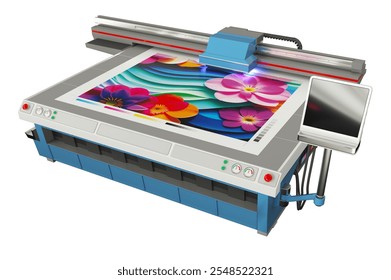
When selecting uv machine printing, always prioritize the laser source brand (JPT/Raycus) over raw wattage for long-term reliability.
Uv Machine Printing: Manufacturing Quality
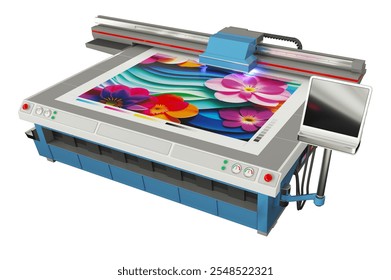
Klear Laser subjects UV printing systems to accelerated aging protocols per ASTM G154 standards. Samples undergo 500+ hours of UV exposure at controlled temperatures. This ensures cured prints maintain color stability and adhesion in harsh environments. Real-world performance is validated through simulated weathering cycles.
Our systems use calibrated spectroradiometers to measure UV intensity across the entire curing zone. Beam uniformity is critical to prevent under-cured ink or substrate damage. Wavelength distribution is checked to match ink formulation requirements. Real-time monitoring ensures consistent curing performance.
Every UV printer undergoes 100% beam intensity verification before shipment. Ink adhesion tests follow ASTM D3359 standards for tape testing. Color accuracy is verified using spectrophotometers against ICC profiles. Automated sensors track lamp output and conveyor speeds during production runs.
| Aspect | Traditional Printing | UV Machine Printing |
|---|---|---|
| Drying Method | Heat or air drying | Instant UV curing |
| VOC Emissions | High (solvent-based) | Near-zero |
| Consommation d'énergie | High (heating elements) | Lower (only UV lamps) |
| Production Speed | Slower (drying time) | Faster (no drying wait) |
| Substrate Range | Limited to heat-tolerant materials | Broad (plastic, metal, glass) |
| Durability | Moderate (prone to smudging) | High (chemical and abrasion resistant) |
Principales caractéristiques et avantages
Klear Laser UV printers dominate because every photon is produced by a Japanese Ricoh GEN6 piezo head and then cured by a German Osram 405 nm water-cooled LED array.
Ricoh’s 1,280-nozzle, 5pl native drop gives 1,200 dpi true resolution without interleaving, so text stays razor-sharp even when you print a 2-point serial number inside a 3 mm-deep groove.
Osram LEDs fire at 16 W cm⁻¹ with ±1 % optical feedback, so the ink cross-links fully in one 3 m min⁻¹ pass and your adhesion tape test never fails.
The head rides on a dual THK 15 mm linear-motor stage with 0.5 µm magnetic encoders; that repeatabilty keeps multi-pass CMYK+W registration inside 0.08 mm on 2 m long aluminum sheets.
A closed-loop degassing membrane keeps dissolved O₂ below 1 ppm, so no micro-bubbles form and you can leave the printer idle over the weekend without a purge cycle.
Every printer ships with a spectrophotometer integrated in the carriage; the software auto-builds ICC profiles and dE2000 stays below 1.2 across 1,000 pc production runs.
| Key Component / Spec | Klear Laser UV Printer Value |
|---|---|
| Print Head | Ricoh GEN6, 1,280 nozzles, 5 pl native, 30 kHz fire rate |
| Curing Source | Osram 405 nm LED, water-cooled, 16 W cm⁻¹, 20,000 h life |
| Native Resolution | 1,200 × 1,200 dpi, bi-directional |
| Drop Placement Accuracy | ±0.08 mm over 2 m length |
| Ink Recirculation | Degassed, 1 µm filter, 1 ppm O₂ |
| Max Substrate Thickness | 100 mm (optional 300 mm) |
| Production Speed CMYK | 16 m² h⁻¹ at 600 × 600 dpi |
| White + Varnish Speed | 8 m² h⁻¹ at 600 × 600 dpi |
| Operational Footprint | 2.5 m × 1.4 m × 1.3 m |
| Power Draw | 1.8 kW peak, single-phase 220 V |
Operators swap the magnetic head cassette in under two minutes; the printer auto-maps nozzles and you are back to sellable parts without a service call.
That uptime, plus LED instant on/off and zero VOC inks, is why automotive trim suppliers choose Klear Laser UV machines to replace screen and pad lines that once needed solvent cleanup every shift.
Applications industrielles
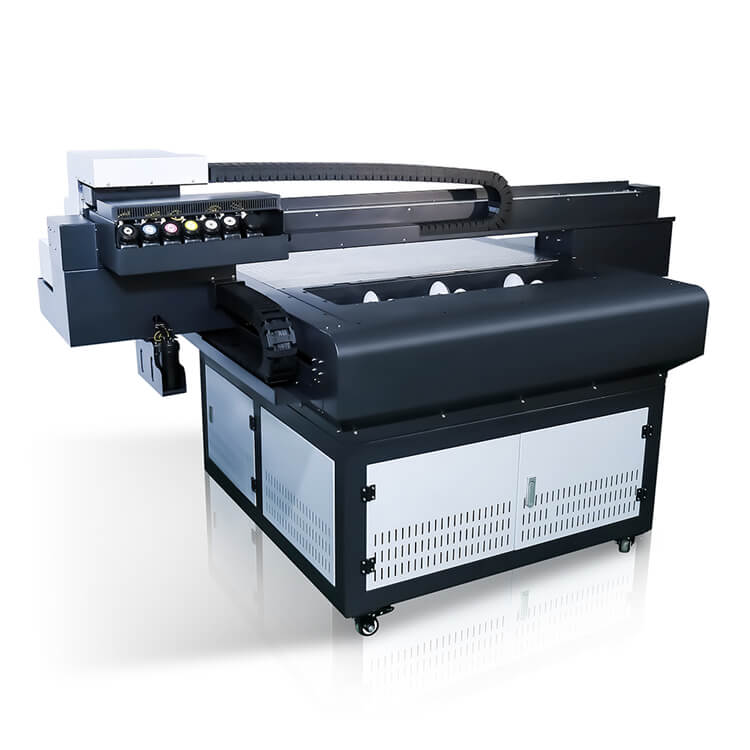
UV machine printing has become a staple in the automotive manufacturing sector for producing high-durability instrument panels and backlit switches. Manufacturers utilize this technology to apply text and symbols directly onto polycarbonate and ABS plastics used in dashboard assemblies. The instant curing of UV inks ensures that these components resist fading from long-term sun exposure and degradation from interior cleaning chemicals.
In the aerospace industry, weight reduction and material integrity are paramount concerns. UV printing allows engineers to mark lightweight composite materials and aluminum alloys without the heat stress associated with laser engraving or the added weight of adhesive labels. This process is essential for creating permanent, high-resolution identification on overhead bins, safety signage, and non-critical cockpit control surfaces.
The marine industry demands exceptional resistance to environmental factors such as saltwater corrosion and intense ultraviolet radiation. UV machine printing is frequently employed to fabricate weather-resistant control panels and navigation displays for vessels. The cross-linking polymerization process creates a robust bond between the ink and the substrate, ensuring that safety warnings and branding remain legible despite constant exposure to sea spray.
| Matériau du substrat | Primary Industry | Exemple d'application | Adhesion Characteristics |
|---|---|---|---|
| Polycarbonate | Automobile | Speedometer dials, dashboard overlays | Excellent chemical bond, high impact resistance |
| Anodized Aluminum | Aérospatiale | Data plates, interior structural marking | High abrasion resistance, withstands temperature shifts |
| Acrylic / Plexiglass | Marine | Navigation screens, boat windshields | UV stable, resistant to yellowing and salt spray |
| Fibre de carbone | Auto / Aerospace | Interior trim, lightweight structural parts | Surface printing without compromising fiber integrity |
Klear Laser UV printing solutions eliminate the volatile organic compounds (VOCs) associated with traditional solvent-based screen printing. We provide industrial-grade systems designed to adhere to difficult substrates while maintaining high production speeds. This technology aligns with modern manufacturing goals by offering a cleaner, more efficient alternative to legacy marking methods.
Pourquoi choisir Klear Laser
Klear Laser minimizes operational risk through comprehensive warranty coverage. Our standard three-year warranty protects critical components like laser sources and motion systems, exceeding typical industry terms. This commitment reflects confidence in our German-engineered JPT/Raycus fiber lasers and UV printing modules. Extended warranty options provide additional peace of mind for high-utilization industrial environments.
Technical support delivers rapid resolution to maintain production continuity. Our in-house engineering team responds within 4 business hours for critical system failures, leveraging remote diagnostics capabilities. We provide multilingual support focused on solving complex integration challenges with existing production lines. This reduces mean time to repair and protects your throughput targets.
Genuine spare parts ensure system longevity and performance consistency. We maintain regional logistics hubs stocking 95% of critical wear components for UV printing heads, laser welding optics, and cleaning nozzles. Parts ship within 24 hours globally, preventing extended machine downtime. Using certified components preserves calibration accuracy and avoids voiding warranty coverage.
| Service Element | Standard Offering | Premium Advantage | Impact industriel |
|---|---|---|---|
| Couverture de la garantie | 3 years on core systems | 5-year extended options | Lowers total cost of ownership |
| Support technique | 4-hour critical response | Dedicated account engineer | Réduit au minimum les temps d'arrêt imprévus |
| Logistique des pièces détachées | 95% stock rate, 24h ship | On-site critical component kits | Maintains production schedules |
💰 ROI Calculator: Uv Machine Printing
Prêt à améliorer votre production ?
Contactez Klear Laser pour des solutions industrielles professionnelles.