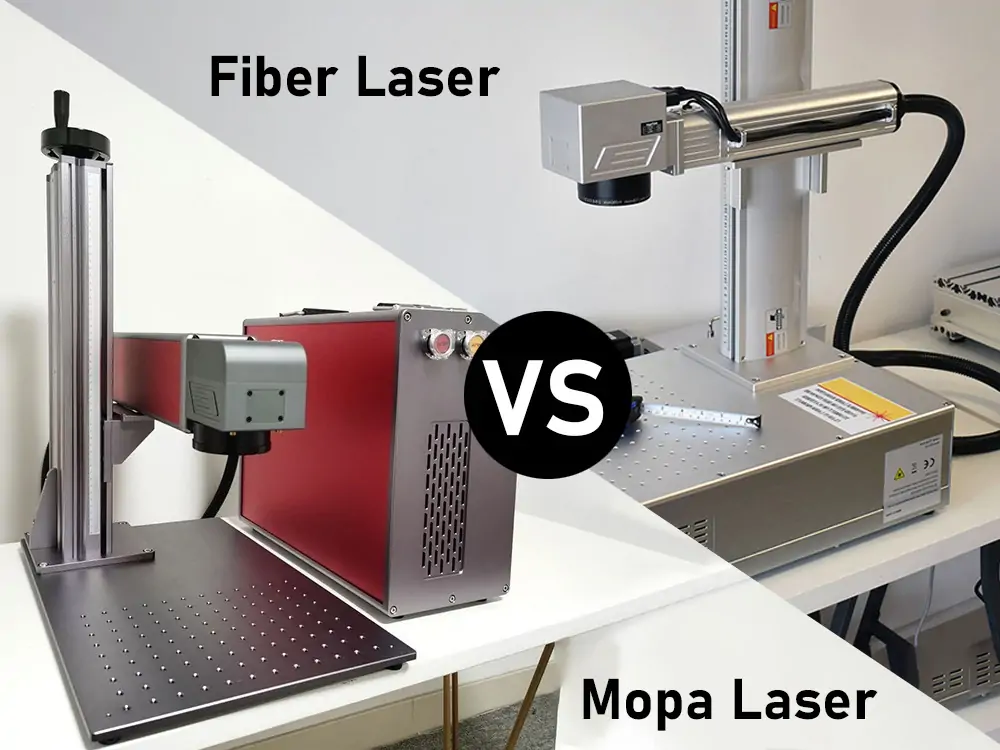
When selecting mopa laser vs fiber laser, always prioritize the laser source brand (JPT/Raycus) over raw wattage for long-term reliability.
Mopa Laser Vs Fiber Laser: Market Trends & ROI
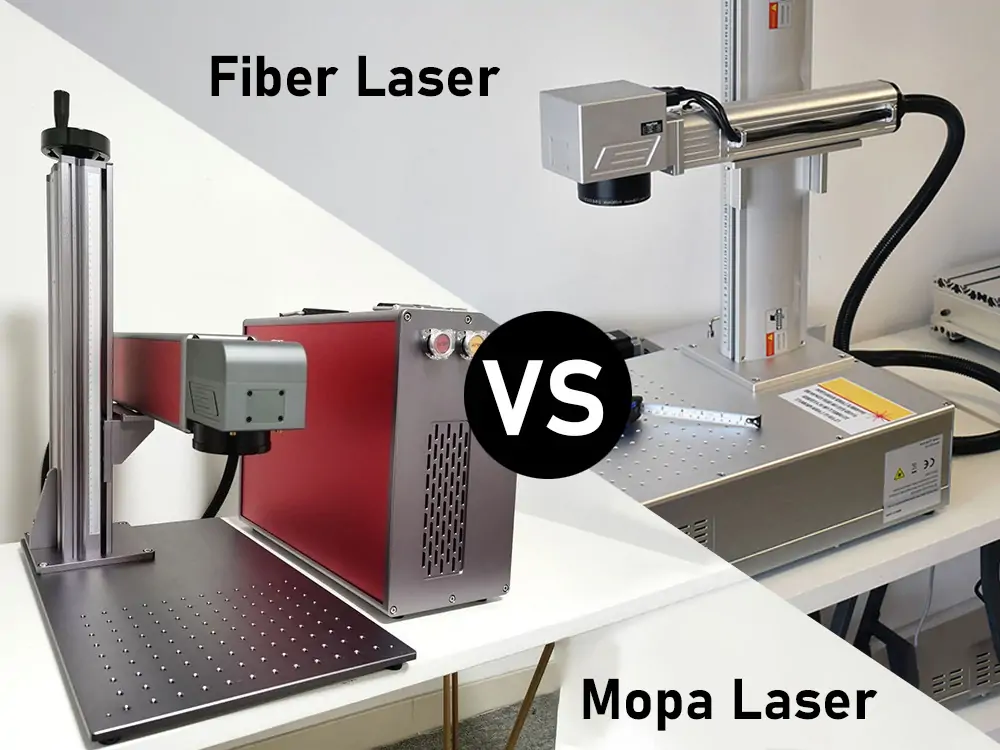
MOPA laser systems deliver superior profitability through reduced operational costs. They eliminate recurring expenses for abrasives and chemicals while minimizing maintenance. This results in a lower total cost of ownership despite higher initial investment.
Industrial demand for MOPA cleaning is surging in precision sectors like aerospace and medical manufacturing. These industries require flawless rust removal without substrate damage. Traditional methods are rapidly declining due to environmental regulations and safety concerns.
| Aspetto | Old Methods | MOPA Laser | Laser a fibra |
|---|---|---|---|
| Efficienza nella rimozione della ruggine | Moderate, inconsistent | High precision, adjustable | Moderate, fixed parameters |
| Controllo dell'ampiezza dell'impulso | Nessuno | Adjustable (5-500ns) | Fixed (typically 100-200ns) |
| Sicurezza del substrato | High damage risk | Excellent, minimal heat | Moderate risk, fixed pulses |
| Operating Costs | High recurring costs | Very low | Low, but less flexible |
| Impatto ambientale | Significant waste | Zero chemical waste | Low waste, dust management needed |
| Industry Demand | Declining rapidly | Rapidly growing | Stable in general use |
MOPA lasers outperform standard fiber lasers through adjustable pulse control. This flexibility handles delicate materials like titanium or aluminum without overheating. Fixed-pulse fiber lasers struggle with variable surface conditions.
Traditional cleaning methods generate hazardous waste and require costly disposal. MOPA technology meets global sustainability standards while improving production efficiency. This drives adoption across regulated industries worldwide.
Caratteristiche e vantaggi principali
Klear Laser builds both types around the same rock-solid Raycus or optional JPT continuous-wave resonator, but the MOPA version adds a second, independently controllable seed laser and acousto-optic modulator. That extra stage lets us dial pulse width from 2 ns to 500 ns while keeping peak power above 30 kW, something a conventional Q-switched fiber engine cannot do.
For cleaning, the variable pulse is the game-changer. A MOPA head running 200 ns at 200 kHz strips thick, scaly rust without overheating the steel beneath, then drops to 20 ns to polish the same surface oxide-free in one pass. Our CW fiber units are fast, but they run fixed 100-120 ns pulses and need two or three slower sweeps to reach white metal, raising the risk of micro-melt on thin auto panels.
Both lines use the same Klear-wobble welding head, yet the MOPA source unlocks precision micro-welds. Drop the frequency to 1 kHz, widen the pulse to 350 ns, and you get 0.2 mm spot penetration on 0.3 mm copper bus bars with zero spatter—perfect for battery tab work where a CW fiber would blow through or add excess heat.
Cooling and delivery hardware are identical, so you can field-upgrade a CW machine to MOPA by swapping the source module and re-loading the parameter library in under 30 minutes. That means one chassis now covers high-throughput rust removal in the morning and fine copper welding in the afternoon, cutting capital expense for job-shop owners who need both capabilities.
Klear Laser MOPA vs CW Fiber Core Specs
| Component / Parameter | MOPA Configuration | CW Fiber Configuration | Impatto industriale |
|---|---|---|---|
| Source Architecture | Raycus/JPT CW + seed laser | Raycus/JPT CW only | MOPA adds tunable pulse on same base |
| Intervallo di larghezza d'impulso | 2 – 500 ns | Fixed ~100 ns | MOPA protects thin substrates |
| Peak Power (clean mode) | ≤ 30 kW | ≤ 15 kW | Deeper oxide lift, faster scan |
| Frequency Sweep | 1 – 4000 kHz | 20 – 100 kHz | MOPA matches rust layer absorption |
| Welding Spot Penetration | 0.05 – 0.4 mm Al/Cu | 0.4 – 2 mm Steel | MOPA for battery tabs, CW for chassis |
| Head Compatibility | Klear-wobble, 0-4 kW auto | Same | One head, two processes |
| Field Upgrade Path | Plug-in seed module | Non disponibile | MOPA turns CW line into multi-tool |
Applicazioni industriali
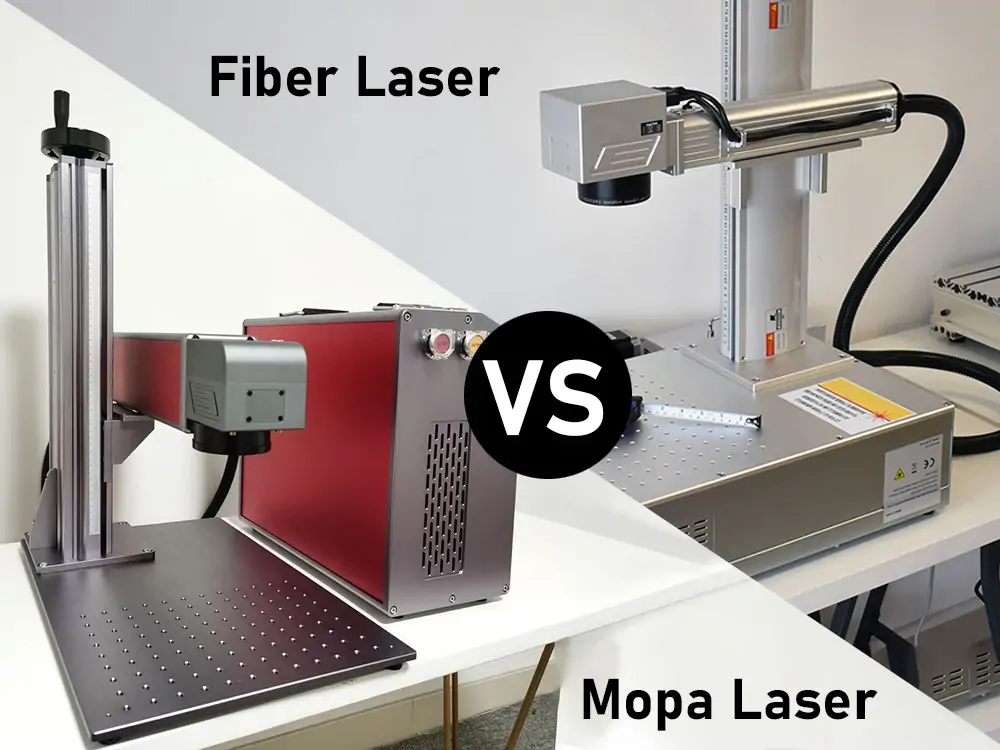
MOPA laser technology represents a sophisticated evolution within the broader category of fiber laser sources. While standard Q-Switched fiber lasers operate with fixed pulse parameters, MOPA (Master Oscillator Power Amplifier) systems allow for independent adjustment of pulse width and frequency. This versatility makes MOPA sources, often manufactured by JPT, the superior choice for applications requiring high precision and minimal thermal impact on the substrate.
In the automotive industry, the distinction between these technologies dictates their specific application on the assembly line. Standard Continuous Wave (CW) fiber lasers equipped with wobble welding heads are utilized for deep penetration welding of chassis components and battery packs. These systems deliver the raw power needed to fuse thick steel or aluminum sheets rapidly. MOPA lasers are conversely used for precise cleaning tasks, such as removing electrolytes from battery cells or cleaning tire molds, where preserving the underlying surface texture is paramount.
Aerospace manufacturing demands the highest levels of substrate safety, making MOPA lasers indispensable for maintenance and paint stripping. When removing coatings from delicate aluminum or composite airframes, the operator must ensure the base material is not compromised by excess heat. By narrowing the pulse width on a MOPA machine, technicians can vaporize paint layers without heating the aerospace-grade alloy beneath. A standard fixed-pulse fiber laser poses a higher risk of micro-cracking or warping these sensitive thin-walled structures.
The marine sector relies heavily on laser technology for combatting corrosion in aggressive saltwater environments. For heavy-duty rust removal on ship hulls or deck plating, high-power standard pulsed fiber lasers provide the aggressive ablation rates necessary for efficiency. However, for cleaning engine components or restoring vintage marine hardware, MOPA lasers are preferred. The ability to fine-tune the pulse energy prevents the pitting of the steel surface, ensuring that the structural integrity of the part remains intact after the rust is removed.
| Material / Substrate | Focus sull'applicazione | Recommended Laser Tech | Technical Reasoning |
|---|---|---|---|
| Aluminum 6061 (Aerospace) | Paint Stripping / Oxide Removal | MOPA Fiber Laser | Adjustable pulse width prevents thermal distortion and preserves the anodized layer or base temper. |
| Acciaio inox 304 | Structural Welding | CW Fiber Laser (Raycus/Max) | Continuous wave output with a wobble head ensures deep penetration and consistent bead profile. |
| Carbon Steel (Heavy) | Thick Rust Removal | Standard Pulsed Fiber | High peak power is required to aggressively ablate thick corrosion layers where surface finish is less critical. |
| Sensitive Electronics | Precision Cleaning | MOPA Fiber Laser | Short pulse durations minimize the Heat Affected Zone (HAZ), preventing damage to delicate circuitry. |
| Galvanized Sheet | Joining / Welding | CW Fiber Laser | High power density overcomes zinc vapor issues to create a strong, porosity-free weld seam. |
When selecting equipment for rust removal, understanding the relationship between pulse width and substrate safety is critical. A standard Q-Switched fiber laser typically operates with a fixed pulse width of around 100-200 nanoseconds, which can transfer significant heat into the part. A MOPA source allows the user to reduce this width to as low as 2 nanoseconds. This capability ensures that the laser energy interacts solely with the contaminant layer, leaving the base metal entirely unaffected.
For welding applications, the choice shifts toward Continuous Wave (CW) fiber lasers rather than pulsed systems. Using reliable sources from JPT or Raycus, these machines provide a stable beam that creates a keyhole effect for deep welding. The integration of a wobble welding head further enhances this process by stirring the molten pool. This action releases gas bubbles and impurities, resulting in a cleaner, stronger weld joint that standard fixed-beam systems cannot achieve.
Perché scegliere Klear Laser
Klear Laser provides 24/7 multilingual technical support with remote diagnostics capabilities. Our certified engineers resolve 85% of issues within two hours, minimizing production downtime for critical industrial operations. Direct factory support ensures accurate troubleshooting for complex laser welding and cleaning applications.
We offer a comprehensive 24-month standard warranty covering all core components including laser sources and motion systems. This extends significantly beyond the typical 12-month industry coverage for fiber and MOFA laser equipment. The warranty explicitly includes JPT and Raycus laser sources, providing assurance for high-value system investments.
Global spare parts availability is guaranteed through strategically located warehouses in North America, Europe, and Asia. Critical components like laser heads, cooling units, and pulsed cleaning nozzles ship within 72 hours worldwide. This operational continuity focus prevents extended line stoppages during maintenance cycles.
| Aspetto del servizio | Klear Laser Standard | Typical Industry Offering |
|---|---|---|
| Assistenza tecnica | 24/7 remote diagnostics, 2-hour resolution target | Business hours only, 24+ hour response |
| Durata della garanzia | 24 months (core components & laser sources) | 12 months (excludes major components) |
| Critical Spare Parts | 72-hour global shipping for welding heads, cleaning nozzles | 1-2 week lead times, limited regional stock |
💰 ROI Calculator: Mopa Laser Vs Fiber Laser
Siete pronti ad aggiornare la vostra produzione?
Contattate Klear Laser per soluzioni industriali professionali.