When selecting how do laser welders work, always prioritize the laser source brand (JPT/Raycus) over raw wattage for long-term reliability.
How Do Laser Welders Work: Technical Specifications
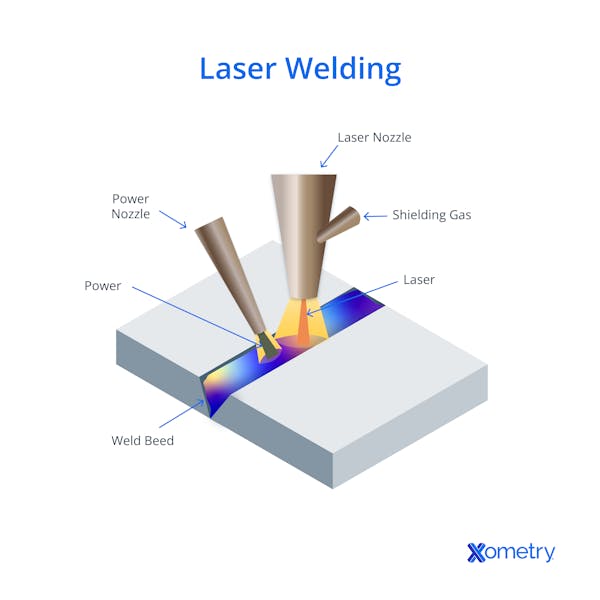
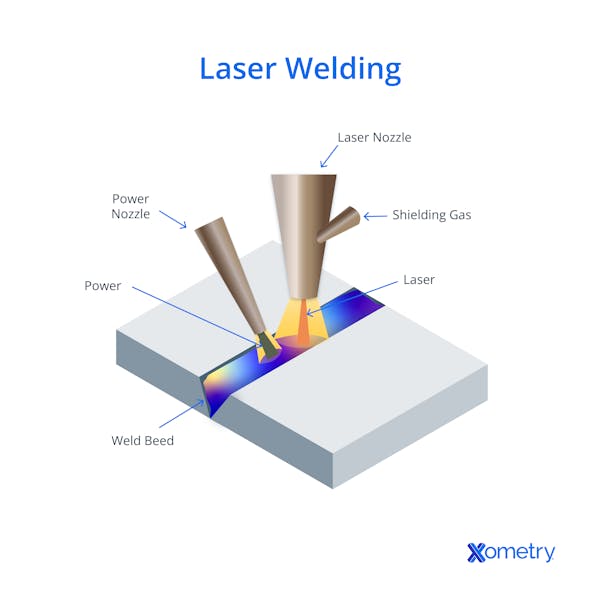
Fiber laser welding operates by generating a high-intensity beam at a specific infrared wavelength, typically around 1064 nanometers. This wavelength is optimal for metal absorption, converting photonic energy into precise thermal energy at the workpiece surface. The beam is delivered through a flexible fiber optic cable from the resonator to the welding head, maintaining beam quality and power density.
The 1064nm wavelength penetrates minimally into metals, creating surface-based melting with exceptional control. Different materials absorb this wavelength at varying rates—steels and stainless steels demonstrate excellent absorption, while highly reflective metals like copper and aluminum require higher peak powers to overcome initial reflectivity. This selectivity enables process optimization for specific industrial alloys.
Pulse energy defines the total energy delivered in each laser pulse, measured in joules. Peak power, calculated as pulse energy divided by pulse duration, determines penetration capability and weld pool dynamics. Short pulse widths with high peak power create deep penetration with minimal heat-affected zones.
Continuous wave (CW) operation delivers sustained energy for deep welds, while pulsed modes offer precise control for thin materials or heat-sensitive components. Pulse frequency and duty cycle adjustments allow operators to fine-tune energy deposition rates. This flexibility makes fiber lasers adaptable across automotive, aerospace, and electronics manufacturing.
Cooling systems are critical for maintaining resonator stability and beam quality. Water cooling dominates industrial systems, circulating through the laser source and welding head to dissipate kilowatts of waste heat. Closed-loop chillers with temperature control within ±1°C prevent thermal drift that degrades weld consistency.
Air-cooled systems exist for lower-power applications but lack the thermal capacity for industrial production. The cooling architecture directly impacts duty cycle and equipment longevity. Proper thermal management ensures 24/7 operation in demanding manufacturing environments.
| パラメータ | 従来のMIG/TIG溶接 | Fiber Laser Welding |
|---|---|---|
| 熱入力 | High, diffuse heat spread | Low, concentrated energy |
| 貫入深度 | 3-5mm typical, limited control | Up to 10mm+ with keyholing |
| 溶接速度 | 0.5-1.5 meters/minute | 2-10 meters/minute |
| Material Distortion | High warping and shrinkage | Minimal, <0.1mm distortion |
| 必要な消耗品 | Electrodes, filler wire, gas | Minimal, no contact parts |
| Operator Skill Level | Years of experience needed | Days to proficiency |
| エネルギー効率 | 30-40% | 45-50% |
| Joint Access | Limited by torch geometry | Excellent, fiber delivery |
Klear Laser integrates JPT and Raycus fiber laser sources, industry-leading resonators known for power stability and longevity. JPT sources offer superior beam quality (M² <1.3) for precision applications. Raycus provides cost-effective reliability for high-throughput production environments.
Wobble welding heads oscillate the beam in programmable patterns, increasing weld width without reducing speed. This technique bridges gaps up to 0.5mm, compensates for fixture inconsistencies, and eliminates filler material. The wobble frequency and amplitude are adjustable in real-time through the control interface.
Penetration depth scales linearly with power density, achieving full penetration in 6mm stainless steel at 2000W with proper focus. Keyhole welding mode creates a vapor channel that enables deep, narrow welds with aspect ratios exceeding 10:1. This mechanism produces stronger joints with less heat input than conventional arc processes.
Our fiber laser welders replace polluting processes with clean, electric-powered precision. The technology eliminates grinding, reduces material waste, and removes hexavalent chromium fumes associated with stainless steel TIG welding. Klear Laser systems deliver ROI through productivity gains and environmental compliance in modern manufacturing facilities.
主な特徴と利点
Klear Laser’s welding superiority stems from integrating premium core components and advanced motion systems. The heart lies in our industrial-grade laser sources from JPT and Raycus. These fiber laser oscillators deliver exceptional beam quality (BPP < 1.2 mm·mrad), high electro-optical conversion efficiency (>30%), and outstanding power stability (±2%). This ensures deep, consistent penetration and minimized heat-affected zones for critical applications.
The welding head is engineered for precision and versatility. Our high-precision linear motor stages provide 0.01mm positioning accuracy, crucial for tight tolerances. The wobble welding head features programmable oscillation patterns (0-10mm amplitude, 0-500Hz frequency) to bridge gaps, manage joint fit-up variations, and achieve uniform penetration profiles. Integrated laser scanner sensors (IP67) provide real-time seam tracking and closed-loop control, automatically adjusting parameters based on actual weld pool dynamics.
| コンポーネント | クリアレーザーの仕様 | Competitor Typical Spec | Klear Advantage |
|---|---|---|---|
| レーザー光源 | JPT/Raycus Fiber Lasers | Generic or Lower-Tier Fiber Sources | Higher beam quality, efficiency (>30%), stability (±2%) |
| Weld Head Motion | Linear Motor Stages (0.01mm accuracy) | Ball Screws or Stepper Motors | Faster speed, superior precision, minimal maintenance |
| Wobble Function | 0-10mm amplitude, 0-500Hz frequency | Limited range/frequency, fixed patterns | Superior gap bridging, controlled penetration profiles |
| プロセス制御 | Real-time laser scanner + closed-loop | Limited open-loop control | Automatic adjustment, consistent weld quality |
| 冷却 | Industrial Chiller (±0.5°C stability) | Basic Air Cooling or Low-End Chillers | Optimal source longevity, consistent output power |
This integration of top-tier sources, precision motion, intelligent wobble, and real-time closed-loop control creates a system delivering unmatched repeatability, process robustness, and final weld integrity.
産業用途
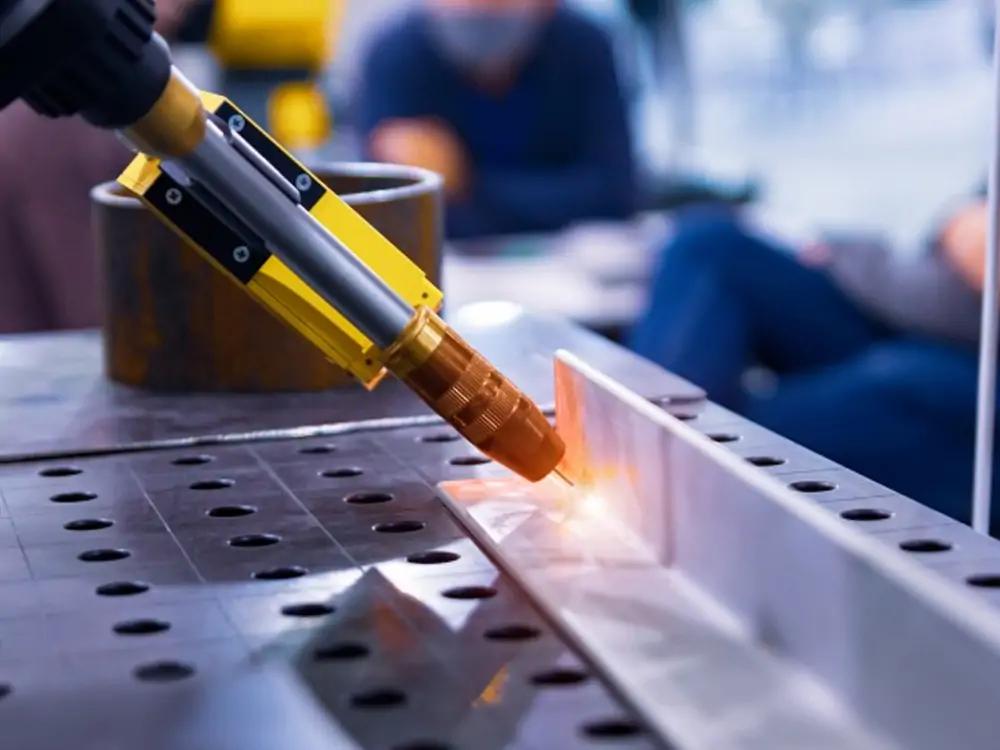
Laser welders are widely used in the automotive industry for high-precision joining of structural components, battery tabs in electric vehicles, and transmission systems. The deep penetration and narrow weld bead minimize distortion, making them ideal for automated production lines. Fiber laser sources from JPT or Raycus provide stable, high-power output essential for consistent weld quality.
In aerospace applications, laser welding is employed for turbine engine components, fuselage panels, and fuel systems where reliability under extreme conditions is critical. Wobble welding heads enable controlled heat input, allowing dissimilar metals like titanium and nickel alloys to be joined without cracking. The process ensures metallurgical integrity while reducing the need for post-weld machining.
Marine engineering utilizes laser welding for constructing corrosion-resistant propulsion systems and offshore structural parts. The ability to achieve full penetration welds on thick-section stainless steel and duplex alloys improves durability in saltwater environments. Pulse modulation and beam shaping allow welding near heat-sensitive zones without compromising substrate integrity.
| 素材 | 一般的なアプリケーション | Weldability with Fiber Laser | 代表的な厚さの範囲(mm) |
|---|---|---|---|
| ステンレス鋼 | Marine shafts, aerospace ducts | 素晴らしい | 0.5 – 15 |
| アルミニウム合金 | EV battery cases, aircraft skins | Good (requires wobble control) | 1.0 – 8 |
| チタン合金 | Jet engines, marine heat exchangers | 素晴らしい | 0.8 – 10 |
| 炭素鋼 | Automotive frames, ship hulls | 非常に良い | 1.0 – 20 |
| Nickel-Based Superalloys | Turbine blades, combustion chambers | 素晴らしい | 0.5 – 12 |
クリアレーザーを選ぶ理由
Klear Laser provides 24/7 global technical support with immediate remote diagnostics and on-site engineer deployment. Our team resolves issues within hours to prevent production halts. All support includes operator training and preventive maintenance guidance. This ensures continuous operation for critical industrial processes.
We offer a 2-year comprehensive warranty covering all laser sources and critical subsystems. Unlike industry standards, our warranty includes both parts and labor replacements. This provides peace of mind and long-term reliability for your manufacturing operations.
Our global spare parts inventory maintains 95% of critical components in stock for immediate shipment. Most parts ship within 24 hours worldwide. This minimizes downtime and keeps your production line running without delays.
| アスペクト | クリアレーザー | Industry Benchmark |
|---|---|---|
| テクニカルサポート | 24/7 remote diagnostics & on-site | 営業時間内のみ |
| 保証範囲 | 2 years (parts & labor) | 1 year (parts only) |
| スペアパーツ | 95% in stock, 24h global shipping | 4-6 week lead times |
💰 ROI Calculator: How Do Laser Welders Work