When selecting uv laser vs fiber laser, always prioritize the laser source brand (JPT/Raycus) over raw wattage for long-term reliability.
Uv Laser Vs Fiber Laser: Case Study
A shipbuilder replaced sandblasting with fiber laser cleaning for hull maintenance. The new system removed rust in 25 minutes per section versus three hours previously. Operators reported no substrate damage when pulse width settings were optimized.
For component marking, UV lasers delivered micron-level precision without affecting plastic surfaces. Traditional inkjet printing had caused frequent rework due to smudging. The switch eliminated chemical waste entirely.
| メートル法 | 従来のサンドブラスト | UV Laser (Marking) | Fiber Laser (Cleaning) |
|---|---|---|---|
| Rust Removal Speed | 3 hours per hull section | 該当なし | 25 minutes per section |
| Marking Precision | Manual scribing (±0.5mm) | ±0.01mm detail | 該当なし |
| パルス幅 | 該当なし | 2ns for high-res marks | 100ns-1ms for cleaning |
| 環境への影響 | Toxic dust, abrasive disposal | No chemicals | No waste, no consumables |
主な特徴と利点
Klear Laser builds two fundamentally different photon engines.
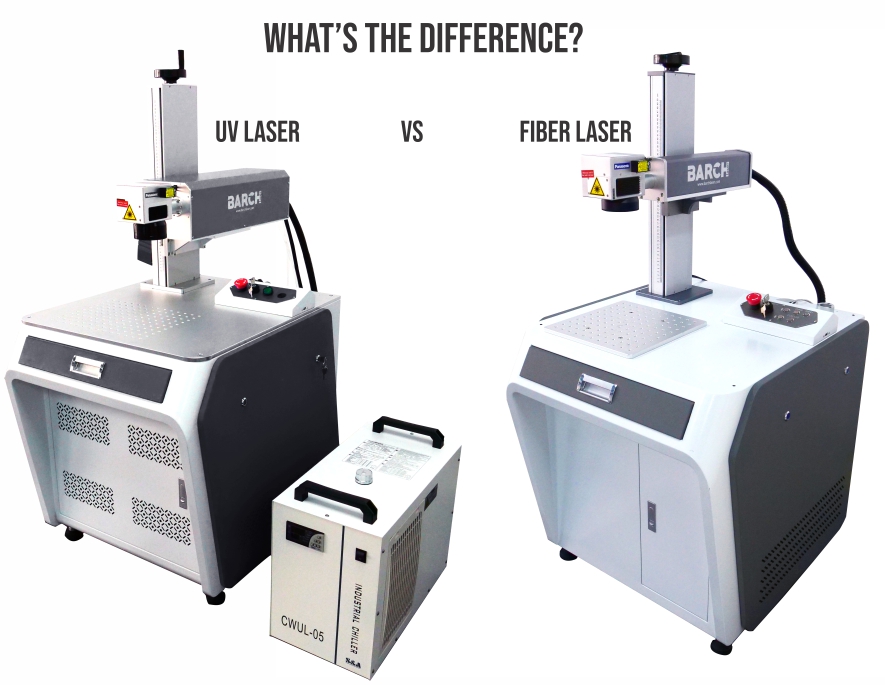
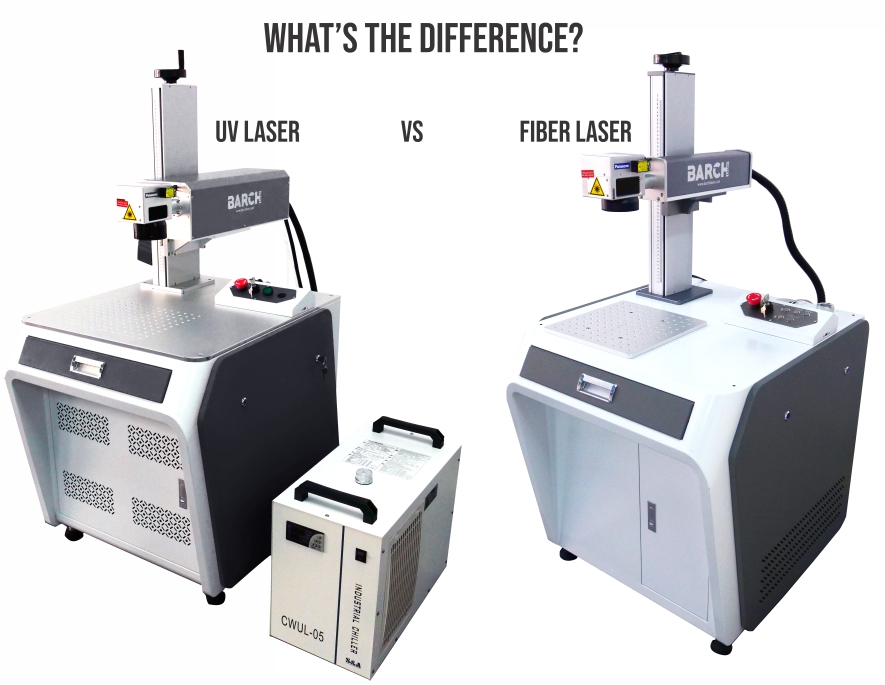
Our UV platforms run sealed DPSS 355 nm sources that crank 20 kHz–200 kHz pulses <15 ns wide; the beam exits cold, so historic bronze bearings or 30 µm Kapton circuits survive cleaning or marking without heat tint.
Fiber engines are 1 µm beasts: single-mode JPT/Raycus QBH modules at 1–4 kW CW or 20 kW quasi-CW spike, married to our dual-axis wobble welder that steers 3 mm of melt pool in real time to fill 0.3 mm gaps in 6 mm aluminum—no filler, no porosity.
The heads tell the rest of the story.
UV machines carry Klear’s F-theta 163 mm lens set, fused-silica, full 400 × 400 mm field, and a sealed z-axis so brake dust can’t reach optics; spot hold is ≤10 µm over the entire plane, giving MEMS lines crisp edges.
Fiber welders snap into our KW-Wobble-40 head: 40 mm aperture, water-cooled mirrors, <1 mrad drift at 4 kW, and internal accelerometers that shut the laser in 2 ms if the robot jerks—saving your $8 k QBH cable and the part.
Below is the side-by-side component sheet we hand to integrators when they have to pick between cold-light finesse and deep-penetration brute force.
| Component / Spec | Klear UV-50 (Cold-Clean) | Klear Fiber-2000 (Deep-Weld) |
|---|---|---|
| レーザー光源 | Diode-pumped 355 nm, 50 W air-cooled | JPT 2 kW single-mode, water-cooled QBH |
| パルス幅 | 8–15 ns @ 20–200 kHz | CW to 20 kW peak (modulated) |
| Typical Process | Oxide/ink removal, 0.05 mm steel | 6 mm stainless full-pen, 0.9 mm Al |
| Optics Head | F-theta 163 mm, fused silica | KW-Wobble-40, 40 mm aperture |
| スポットサイズ | 18 µm (1/e²) | 50 µm core + 0–3 mm wobble |
| 冷却 | TEC + ambient air, no chiller | 24 l/min closed-loop, 28 °C |
| Electronics | 48 V low-voltage safety bus | 3-phase 380 V, EtherCAT <1 ms |
| MTBF Source | >20 000 h diode pack | >100 000 h JPT module |
| Price Position | Premium cold process | Shop-floor workhorse |
産業用途
In the automotive and marine industries, Fiber Lasers are the primary solution for heavy-duty structural applications due to their high power and thermal efficiency. When utilized for welding, our machines employ reliable JPT or Raycus sources to achieve deep penetration on thick carbon steel and aluminum frames. The inclusion of wobble welding heads allows the beam to oscillate, creating a wider weld seam that bridges gaps effectively and ensures hermetic seals on electric vehicle battery enclosures.
For maintenance and restoration in aerospace and marine environments, Pulsed Fiber Lasers serve as a superior cleaning technology. These systems remove heavy rust, oil, and marine coatings by delivering high-peak power pulses that vaporize contaminants instantly. By carefully calibrating the pulse width, operators can strip paint from aluminum aircraft skins or remove oxidation from steel hulls without transferring excess heat that would compromise the substrate safety or structural integrity.
Conversely, UV Lasers utilize a much shorter wavelength (355 nm) to perform “cold processing” through photochemical ablation. This technology is essential in the aerospace sector for marking wire insulation and processing heat-sensitive polymers where fiber lasers would cause melting or burning. UV systems create high-contrast marks on glass, circuit boards, and dashboard plastics without generating thermal stress, ensuring that delicate components remain physically unaltered during the identification process.
Material Compatibility and Application Comparison
| 素材タイプ | Fiber Laser (1064 nm) Application | UV Laser (355 nm) Application | 相互作用のメカニズム |
|---|---|---|---|
| ステンレス鋼 | Deep penetration welding and heavy rust removal. | High-contrast annealing or marking. | Thermal Melting vs. Surface Oxidation |
| アルミニウム | Structural wobble welding and oxide cleaning. | Surface marking without warping. | Thermal Fusion vs. Cold Ablation |
| Glass | Generally not suitable (passes through). | Micro-drilling and surface etching. | Low Absorption vs. High Absorption |
| Plastics/Polymers | Limited (often melts or burns material). | High-contrast marking and cutting. | Thermal Damage vs. Photochemical Breaking |
| 銅/真鍮 | Effective with high power and wobble heads. | Surface marking only. | High Reflectivity Management vs. Surface Absorption |
クリアレーザーを選ぶ理由
Klear Laser guarantees operational continuity with 24/7 technical support. Our certified engineers resolve complex integration or process issues within 24 hours globally. Dedicated account managers provide proactive maintenance scheduling for your fiber welding or laser cleaning systems. This minimizes unplanned downtime in critical production environments.
We offer an industry-leading 3-year comprehensive warranty covering all core components including JPT/Raycus laser sources and motion systems. This exceeds the standard 1-2 year coverage from competitors. The warranty includes both parts and labor with no hidden fees. It ensures substrate safety during pulsed cleaning or high-precision welding operations throughout the coverage period.
Genuine spare parts ship within 72 hours worldwide from our US, EU, and APAC hubs. We stock critical wear items like galvanometer scanners, fiber delivery cables, and cleaning nozzles. Using OEM parts maintains system calibration for precise wobble welding patterns or controlled rust removal pulse widths. This rapid availability prevents extended machine idleness.
| Service Pillar | 業界標準 | Klear Laser Commitment | 業務への影響 |
|---|---|---|---|
| テクニカルサポート | 48-72 hour response | 24 hour resolution | Eliminates production uncertainty |
| 保証範囲 | 1-2 years (parts only) | 3 years (full labor + parts) | 総所有コストの削減 |
| スペアパーツ | 5-10 day fulfillment | 72 hour global shipping | Maximizes annual machine uptime |
💰 ROI Calculator: Uv Laser Vs Fiber Laser