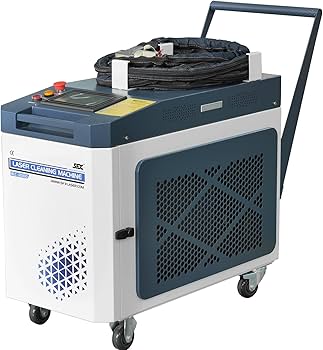
When selecting lazer rust remover, always prioritize the laser source brand (JPT/Raycus) over raw wattage for long-term reliability.
Lazer Rust Remover: Technical Specifications
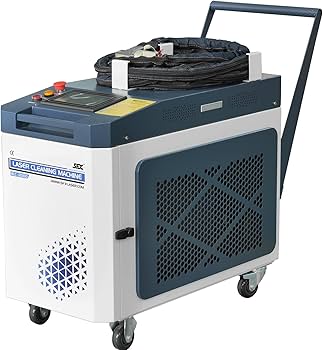
Laser rust removal operates through precise photophysical interactions where specific wavelengths target iron oxide layers while preserving underlying substrates. The process relies on nanosecond-pulsed fiber lasers that deliver concentrated energy bursts to vaporize contaminants without abrasive contact. This non-destructive approach fundamentally changes industrial maintenance by eliminating secondary waste streams and chemical hazards.
Wavelength selection directly determines absorption efficiency and material compatibility. Most industrial systems operate at 1064 nm, where rust and mill scale absorb laser energy intensely while steel substrates reflect most of the incident radiation. This differential absorption creates a self-limiting effect that protects the base metal once the oxide layer is removed. Shorter wavelengths in the visible spectrum show promise for more delicate applications but lack the raw power for heavy corrosion.
Pulse energy, typically ranging from 0.5 to 30 mJ in commercial systems, controls both cleaning speed and substrate safety. Higher pulse energies accelerate thick rust removal but require careful parameter tuning to avoid microstructural changes in heat-sensitive materials. The energy density must exceed the ablation threshold of iron oxide while remaining below the melting point of the underlying metal. Advanced systems modulate pulse energy in real-time based on surface feedback, ensuring consistent results across varying corrosion thicknesses.
Pulse width, usually 100-250 nanoseconds, is equally critical for thermal management and selective ablation. Shorter pulses confine heat to the contaminant layer, preventing heat-affected zones in the substrate. This temporal precision allows operators to remove rust from thin-gauge materials, painted surfaces, and even historical artifacts without distortion. The pulse repetition frequency, adjustable from 20 to 200 kHz, balances cleaning speed with thermal accumulation control.
Cooling systems determine machine reliability in continuous industrial operations. Pulsed laser rust removers generate substantial heat in the laser diodes and Q-switch assemblies, requiring active temperature regulation. Most industrial units employ closed-loop water cooling with dual-circuit designs that isolate the optical path from the power electronics. This architecture maintains diode temperatures within ±1°C, ensuring beam quality stability and extending source lifetimes beyond 100,000 hours.
Ambient operating conditions directly impact cooling efficiency and maintenance schedules. High-humidity environments necessitate dehumidified cooling loops to prevent condensation on optical surfaces. Portable systems often integrate air-cooled designs for field operations, though these sacrifice some power density for mobility. Proper cooling maintenance prevents thermal lensing effects that would otherwise degrade beam focus and cleaning consistency.
| Methode | Precisie | Substraatschade | Milieu-impact | Bedrijfskosten | Efficiency |
|---|---|---|---|---|---|
| Zandstralen | Low (±2mm) | High (surface profiling) | Severe (dust waste) | Medium (media disposal) | Matig |
| Chemical Baths | Medium (±1mm) | Moderate (etching) | High (toxic runoff) | High (chemical purchase) | Langzaam |
| Laserreiniging | Very High (±0.1mm) | Minimal (no heat affect) | Minimal (no consumables) | Laag (alleen elektriciteit) | Very Fast |
Industrial applications demand robust systems with automated parameter libraries for different rust grades. Klear Laser cleaning platforms integrate real-time power monitoring and beam delivery diagnostics to maintain process consistency across shift changes. The technology eliminates masking requirements for selective surface preparation, making it ideal for weld prep, coating removal, and maintenance in sensitive environments like food processing or pharmaceutical equipment.
Belangrijkste functies en voordelen
Here’s why the Klear Laser pulsed laser cleaning machine excels at rust removal, focusing on critical components:
Superior Laser Source: We integrate high-performance JPT or Raycus pulsed fiber laser sources. These MOPA (Master Oscillator Power Amplifier) architecture sources deliver exceptionally high peak power pulses. This high peak power is crucial for efficiently ablating rust and oxides without excessive heat input. Crucially, they offer a long, adjustable pulse width (typically 100ns – 300µs), allowing precise control over the interaction time. This combination ensures effective contaminant removal while maximizing substrate safety by minimizing thermal distortion and heat-affected zones.
Advanced Scanning & Optics Head: The heart of the cleaning process is our precision scanning head. It features motorized focus adjustment for rapid adaptation to different tasks and substrates. A patented beam homogenizer and shaping nozzle ensure a top-hat intensity profile and uniform energy distribution across the cleaning spot. This leads to consistent removal rates and protects delicate substrates from pinpoint damage. The head’s robust design and integrated protective optics ensure long-term reliability in demanding industrial environments.
Klear Laser Cleaning Machine Key Specifications
| Functie | Specification (Typical Range) |
|---|---|
| Laserbron | JPT or Raycus Pulsed Fiber Laser |
| Gemiddeld vermogen | 20W – 100W (Configurable) |
| Pulsbreedtebereik | 100 nanoseconds – 300 microseconds |
| Herhalingsfrequentie | 1 kHz – 100 kHz |
| Stralingskwaliteit (M²) | < 1.5 |
| Scanning Field | Up to 100mm x 100mm (Customizable) |
| Minimum Cleanable Spot | ~0.1mm |
| Max. Rust Removal Rate | Up to 500 cm²/min (Dependent on layer) |
The synergy between our high-peak-power, adjustable-pulse-width source and the precision, homogenized-beam scanning head delivers superior cleaning efficiency and substrate protection. This combination allows for precise ablation of contaminants like rust, mill scale, and oxides from diverse metals while preserving the integrity of the underlying base material.
Industriële toepassingen
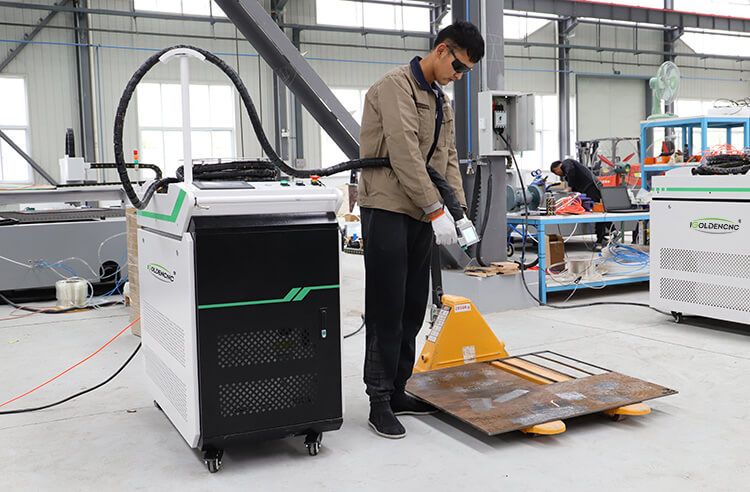
Laser rust removers are widely used in the automotive industry for precision cleaning of chassis components, engine parts, and车身 assemblies. The non-abrasive nature of pulsed laser cleaning ensures delicate substrates are not damaged during rust and oxide removal. This process supports rework and restoration tasks without compromising material integrity.
In aerospace, laser rust removal is critical for maintaining high-strength aluminum alloys and titanium components. These materials are prone to corrosion in humid or saline environments, and traditional sandblasting can weaken surfaces. Pulsed fiber lasers with adjustable pulse width (10–200 ns) selectively ablate rust while preserving protective oxide layers underneath.
Marine applications include deck hardware, propellers, and seawater-exposed steel structures. Saltwater accelerates corrosion, making frequent maintenance essential. Laser cleaning eliminates flash rust and old coatings from ship hulls without creating secondary waste, offering an eco-friendly alternative to chemical strippers.
| Type materiaal | Surface Condition | Max Safe Pulse Energy (mJ) | Typical Pulse Width (ns) |
|---|---|---|---|
| Koolstofarm staal | Heavy rust, mill scale | 1.8 | 120 |
| Roestvrij staal | Light oxidation, fingerprints | 1.2 | 80 |
| Aluminiumlegeringen | Corrosion, anodized residue | 0.9 | 60 |
| Titanium | Oxide layer, thermal staining | 1.0 | 70 |
| Koper & Messing | Tarnish, patina | 0.7 | 50 |
Klear Laser’s pulsed cleaning systems use a 1064 nm wavelength with IPG or JPT fiber sources, ensuring stable output for industrial environments. The technology enables selective ablation—removing contaminants while leaving the base material intact—critical for safety-critical sectors like aviation and offshore engineering.
Waarom voor Klear Laser kiezen
Klear Laser provides 24/7 technical support through phone, email, and remote diagnostics. Our global engineering teams respond within hours for urgent issues. On-site service is guaranteed within 48 hours for critical industrial downtime. This ensures minimal disruption to your production schedule.
All Klear Laser systems include a standard 2-year warranty covering major components and labor. Extended warranty options are available for high-uptime applications. Terms are transparent with no hidden exclusions. This protects your investment against unexpected repair costs.
We maintain a global inventory of genuine spare parts for rapid delivery. Critical components ship same-day to avoid production halts. All parts undergo strict quality testing for perfect compatibility. This keeps your equipment running at peak efficiency year-round.
| Categorie | Belangrijke gegevens | Industrieel voordeel |
|---|---|---|
| Ondersteuning | 24/7 remote support, on-site service within 48h | Minimizes production downtime with rapid response |
| Garantie | 2-year coverage, extendable terms, no hidden exclusions | Protects investment with reliable long-term service |
| Onderdelen | Global inventory, same-day shipping, genuine components | Ensures continuous operation and peak machine performance |
💰 ROI Calculator: Lazer Rust Remover
Klaar om uw productie te upgraden?
Neem contact op met Klear Laser voor professionele industriële oplossingen.