When selecting laser paint removal cost, always prioritize the laser source brand (JPT/Raycus) over raw wattage for long-term reliability.
Laser Paint Removal Cost: Manufacturing Quality
Laser Paint Removal: Testing, Analysis & Quality
Aging Tests
Klear Laser subjects pulsed laser cleaning machines to rigorous aging tests. These simulate years of operation in demanding industrial environments. Accelerated life testing validates component longevity, particularly for laser sources and optics. Thermal cycling checks ensure stable performance across fluctuating temperatures.
Beam Analysis
Precise beam characterization is critical. We measure beam quality (M²), profile, and divergence to guarantee consistent paint removal. Short pulse widths minimize substrate heating, preventing warping or damage. Beam profiling ensures uniform energy distribution across the cleaning area for predictable ablation depth.
QC Protocols
Stringent quality control begins with incoming material inspection. In-process testing verifies weld integrity on critical assemblies like oscillator chambers. Final validation includes power output checks, beam diagnostics, and functional cleaning tests on sample panels. Each machine undergoes a 24-hour burn-in test before shipment.
Cost Comparison: Traditional vs Laser Paint Removal
| Metoda | Cost per Sq Ft (Est.) | Labor Intensity | Utylizacja odpadów | Substrate Risk |
|---|---|---|---|---|
| Stripping chemiczny | $1.50 – $3.50 | High (manual) | Hazardous waste | High (corrosion) |
| Piaskowanie | $1.00 – $2.50 | High (manual) | Abrasive waste | High (erosion) |
| Thermal Removal | $1.75 – $4.00 | Średni | Fumes (filtration) | Medium (heat stress) |
| Czyszczenie laserowe | $0.30 – $0.80 (long-term) | Low (automatable) | Minimal | Niski |
Laser technology offers superior cost efficiency over time. Reduced labor, minimal consumables, and no secondary waste disposal significantly lower operational expenses. Precise control ensures substrate safety, eliminating costly rework. Klear’s QC protocols guarantee reliable performance, maximizing return on investment.
Kluczowe cechy i zalety
Klear Laser’s fiber laser cleaning machines deliver superior value in paint and rust removal by leveraging high-efficiency pulsed fiber sources from trusted manufacturers like Raycus and JPT. These sources provide precise control over pulse width and frequency, enabling effective coating ablation without damaging the underlying substrate. The result is longer material life and reduced rework in industrial refurbishment.
The integrated scanning heads feature dynamic galvanometer systems with wobble-compatible optics, allowing adjustable spot size and uniform energy distribution. This ensures consistent removal rates across curved or uneven surfaces, especially in automotive and aerospace applications where precision is critical. The sealed optical path also minimizes maintenance in dusty environments.
Klear Laser optimizes system performance through intelligent source-head synchronization, maximizing cleaning speed while minimizing power consumption. This synergy reduces operational costs over time, making the total cost of ownership lower than competitive models with mismatched components.
| Specyfikacja | Klear Laser Pulsed Cleaning Machine |
|---|---|
| Źródło lasera | Raycus/JPT Pulsed Fiber, 100W–2000W |
| Długość fali | 1064 nm |
| Szerokość impulsu | 10-200 ns (regulowany) |
| Frequency | 20–2000 kHz |
| Głowica skanująca | Galvo with Wobble Function, IP65 |
| Max Cleaning Speed | Up to 50 m²/h (paint), 15 m²/h (rust) |
| Bezpieczeństwo podłoża | Minimal thermal impact on steel, aluminum, composites |
Zastosowania przemysłowe
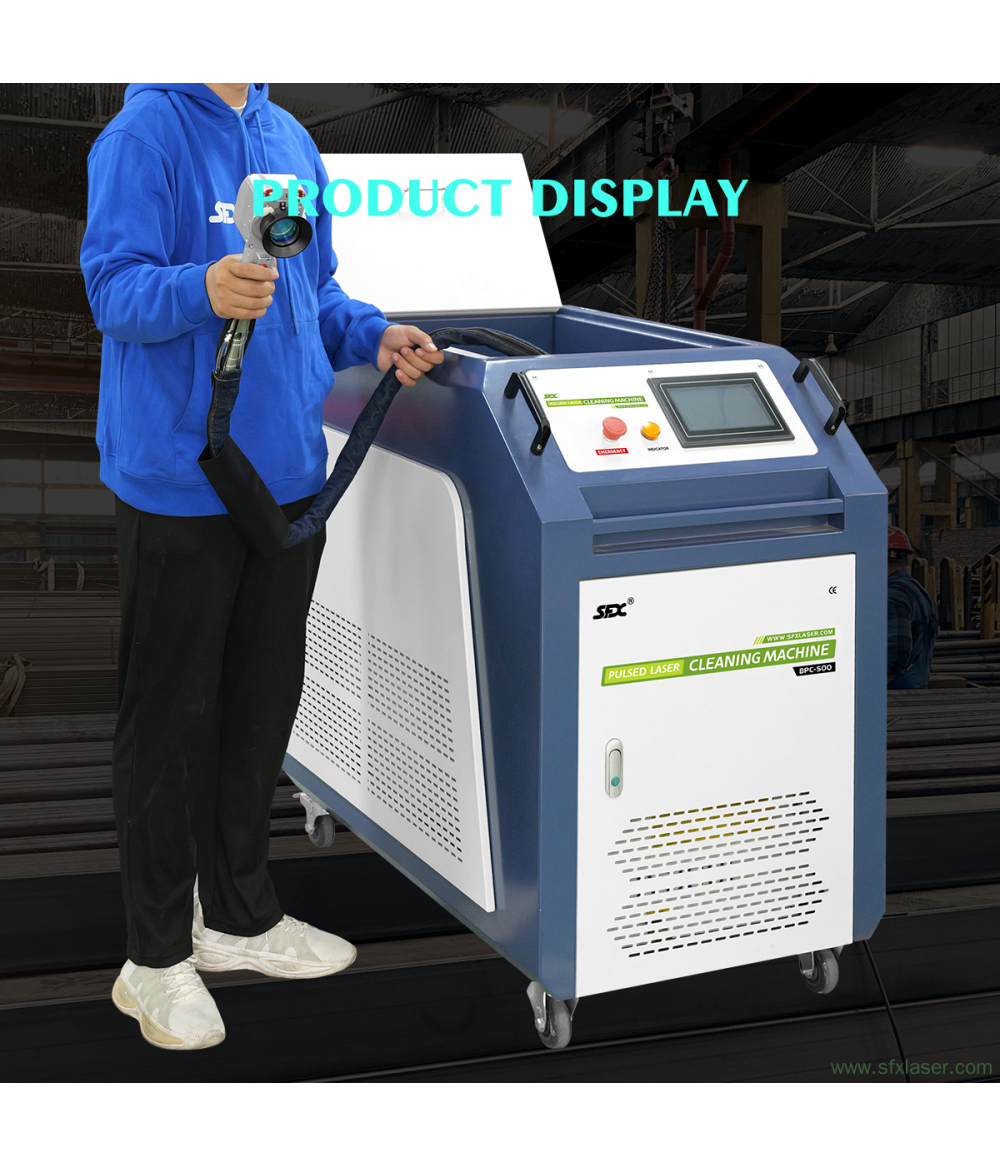
Laser paint removal is extensively applied in the automotive industry for body repair and restoration. It replaces toxic chemical strippers and abrasive sanding, reducing environmental impact and labor costs. Precise control minimizes substrate damage on thin aluminum or steel panels.
Advanced aerospace applications use laser cleaning for turbine blades and structural components. Pulse widths under 100 nanoseconds prevent heat-affected zones in titanium and aluminum alloys. This ensures component integrity while removing paint without altering surface dimensions.
Marine sectors rely on laser systems for hull maintenance and propeller refurbishment. Steel and composite surfaces are cleaned efficiently without damaging anti-corrosion layers. The process avoids water or chemical waste, critical for regulatory compliance.
| Materiał | Przykład zastosowania | Zakres szerokości impulsu | Substrate Safety Considerations |
|---|---|---|---|
| Aluminium | Samochodowe panele nadwozia | 10-100 ns | Low energy prevents melting of thin sheets |
| Stal | Ship hulls and chassis | 50-300 ns | Controlled heat input avoids warping |
| Tytan | Aircraft engine parts | 20-100 ns | Prevents oxidation and maintains structural properties |
| Carbon Fiber Reinforced Polymer (CFRP) | Aircraft wings | 5-50 ns | Non-contact process preserves fiber integrity |
| Copper alloys | Marine propellers | 10-80 ns | Minimal thermal impact avoids material deformation |
Dlaczego warto wybrać Klear Laser
When you invest in a Klear pulsed-laser cleaning system you’re buying more than a cabinet and a scan head; you’re buying uptime on the production floor. Our global service network keeps a 48-hour field-response SLA in North America, the EU and ASEAN, so a paint-stripping nozzle that suddenly drifts 5 % in power is re-calibrated before your quality log shows a reject. Every machine ships with a tablet that streams live beam-parameter diagnostics to our cloud; we often spot a dirty F-theta lens or a chiller filter issue and FedEx the spare part before you notice throughput has dropped.
The warranty is simple: five full years on the pulsed MOPA source, three years on every Galvo scanning head, and lifetime software updates that add new paint-layer recipes we develop for aerospace or EV customers. If an 200 W unit has to ship back to our Shenzhen service hub, we forward-exchange a loaner within 72 h so your paint-removal cell keeps blasting epoxy primer off aluminum substrates at 4 m²/h. No pro-rating, no hidden “consumable” clause—just zero-cost repairs including outbound freight.
Spare-parts economics are where laser paint removal really distances itself from chemical stripping or dry-ice blasting. A 200 W Q-switched source rated at 100 000 h MTBF costs under $0.30 per operating hour; a replacement 254 mm F-theta lens is $680 and lasts 6 000 h even when removing MIL-SPEC polyurethane. We publish a recommended shelf list—focus lens, protective windows, 5 m fiber delivery cable—so your storeroom carries less than $2 000 of inventory and still meets 98 % uptime KPI.
| Komponent | Standardowa gwarancja | Spare-Part Price | Typical Duty Cycle | Exchange Turnaround |
|---|---|---|---|---|
| 200 W MOPA source | 5 yr full | $3 900 | 100 000 h MTBF | 48 h advance swap |
| 254 mm F-theta lens | 3 yr | $680 | 6 000 h on paint | 24 h local courier |
| Galvo scanning head | 3 yr | $1 150 | 30 000 h | 72 h loaner first |
| Chiller filter kit | 1 yr | $45 | 2 000 h | Field replaceable |
| Fiber cable (5 m) | 2 yr | $320 | >50 000 h | Plug-and-play |
Because pulse width, spot size and layer-selective energy density are locked into recipes, any replacement part is pre-calibrated at the factory; you bolt it in, scan the QR code, and the controller reloads parameters so you’re stripping 120 µm epoxy from carbon-fiber EV battery trays without touching the underlying resin.
💰 ROI Calculator: Laser Paint Removal Cost
Gotowy do modernizacji produkcji?
Skontaktuj się z Klear Laser, aby uzyskać profesjonalne rozwiązania przemysłowe.