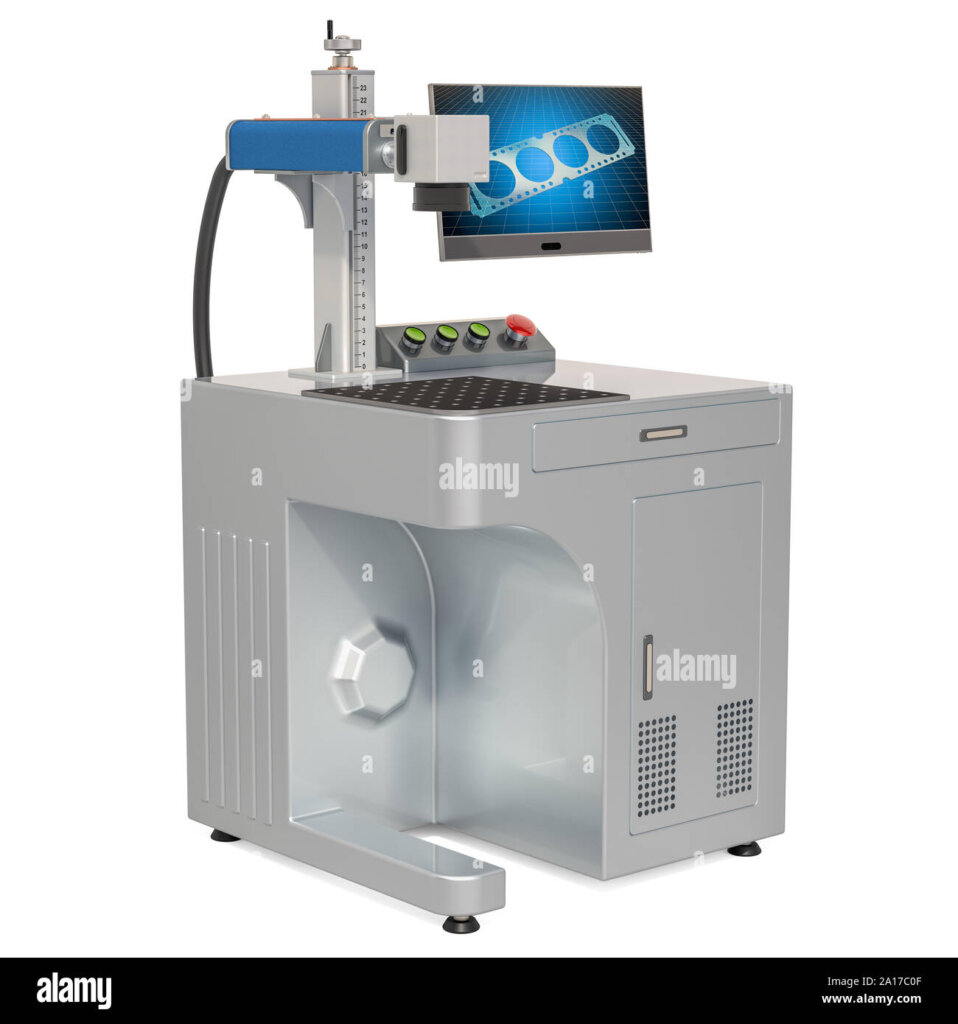
When selecting desktop fiber laser marking machine, always prioritize the laser source brand (JPT/Raycus) over raw wattage for long-term reliability.
Desktop Fiber Laser Marking Machine: Manufacturing Quality
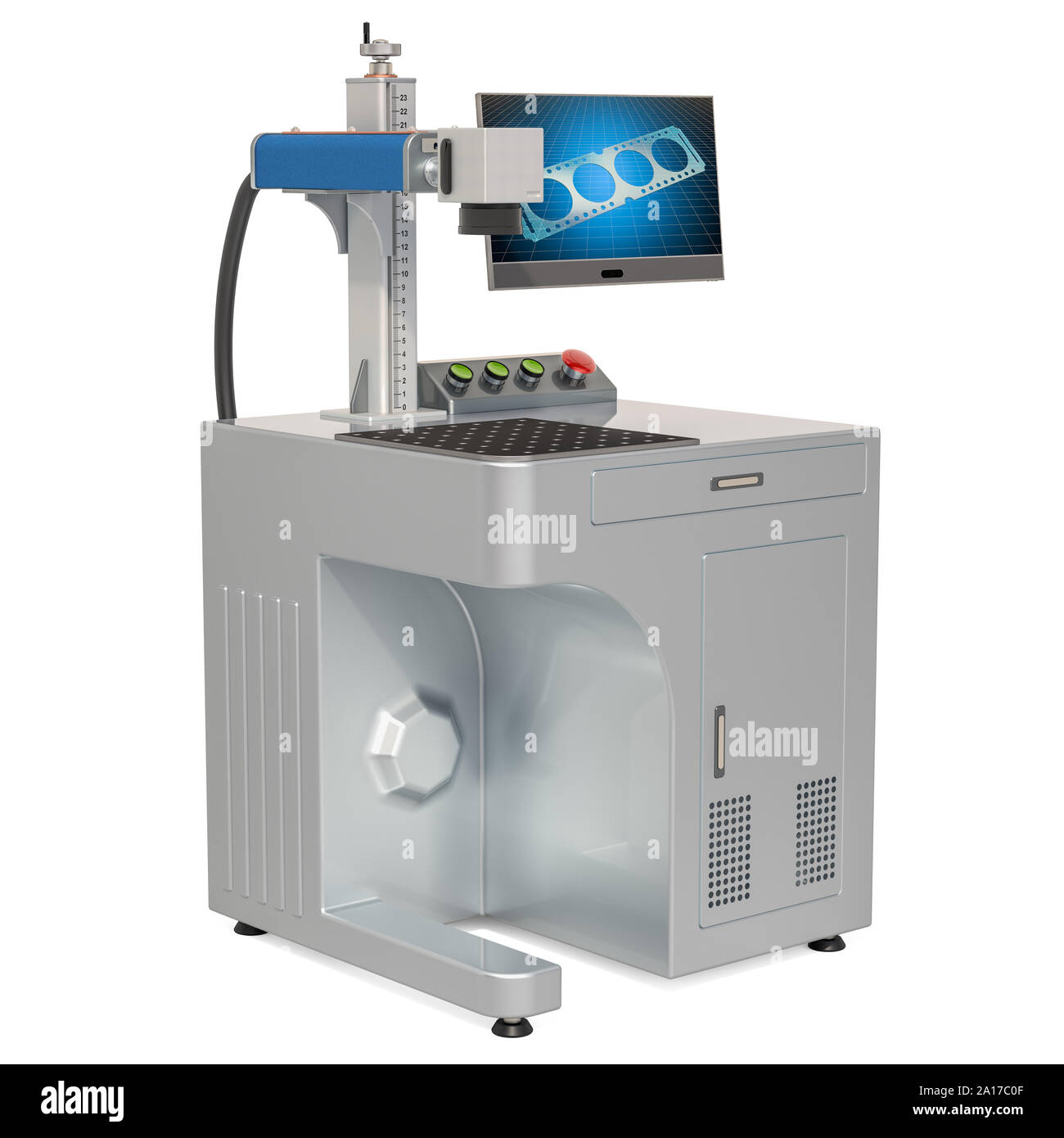
Aging tests validate longevity through continuous operation and thermal cycling. Units undergo 1,000+ hours of stress testing at maximum load. This ensures stability beyond 100,000 operating hours in industrial environments.
Beam analysis uses precision profilers to measure M² factor and focal consistency. Real-time diagnostics monitor spot size and power distribution. This guarantees micron-level accuracy for every marking operation.
QC protocols follow ISO standards with power calibration and alignment verification. Each machine undergoes dynamic marking trials on test samples. Final acceptance checks confirm compliance with customer-specific requirements.
| Aspekt | Metody tradycyjne | Desktop Fiber Laser Marking Machine |
|---|---|---|
| Precyzja | 0.1–0.5 mm | 0.01–0.05 mm |
| Prędkość znakowania | 10–50 mm/s | 100–300 mm/s |
| Material Damage | Mechanical stress causes deformation | Non-contact, zero surface damage |
| Konserwacja | Frequent tool replacement needed | Minimal (optics cleaning only) |
| Wpływ na środowisko | Chemical waste, metal shavings | Zero waste, no consumables |
| Energy Use | Higher mechanical system consumption | 20–30% more efficient than traditional |
Kluczowe cechy i zalety
Klear Laser’s desktop fiber laser marker starts with a sealed, turnkey JPT MOPA source that gives you 0.5–1.5 ns pulse-on-demand control inside a 20 kg desktop cabinet. The M7+ series keeps beam-parameter-product below 1.2 mm·mrad, so the 20 W model still delivers 1.0 mJ per pulse—enough to ablate anodize or mark deep 0.15 mm into stainless without wasting photons. Because we couple the fiber through a quartz block and into a digital-grade 10 mm galvo head, we hold drift under ±0.02 mm over an 8-hour shift and maintain <1 % power loss at the 254 mm focal length.
The scan head itself is a Klear-designed, 2024-class unit with 3-phase servo galvos and 16-bit encoders; that combination hits 15 m s⁻¹ jump speed and 2 kHz tracking bandwidth so you can hatch 0.06 mm fill at 2000 mm s without wobble. A field-focusing f-theta lens with 1064 nm broadband coating keeps spot size at 25 µm across a 110 × 110 mm plane, giving you crisp DataMatrix codes down to 0.2 mm cell size on aluminum tags.
Finally, every desktop unit ships with our KL-Mark 3.0 software on an embedded industrial PC; it auto-tunes pulse width and frequency to the substrate, logs each job to a SQLite archive, and lets you drag-and-drop DXF or BMP files straight into the workspace. The result is a lab-sized machine that behaves like a 24/7 production marker—no chiller, no maintenance, and MTBF >100,000 hr on the JPT source.
| Specyfikacja | KL-20D (Desktop) |
|---|---|
| Źródło lasera | JPT MOPA M7+, 20 W, 1.0 mJ |
| Szerokość impulsu | 0.5–500 ns tunable |
| Beam quality M² | ≤1.2 |
| Max marking speed | 15 m s⁻¹ vector, 2000 mm s⁻¹ hatch |
| Powtarzalność położenia | ±0,02 mm |
| Spot diameter | 25 µm @ 110 × 110 mm field |
| Galvo driver | 16-bit, 3-phase servo |
| Zapotrzebowanie na moc | 110–240 V, 300 W, air-cooled |
| Footprint / weight | 420 × 420 × 190 mm, 20 kg |
| MTBF (source) | >100,000 h |
Zastosowania przemysłowe
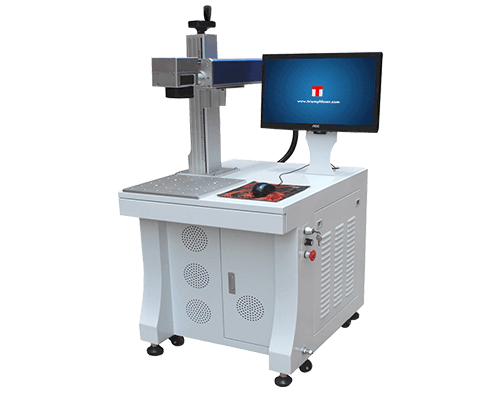
Desktop fiber laser marking machines provide a compact yet powerful solution for permanent direct part marking across heavy industries. These units utilize high-quality fiber sources, often ranging from 20W to 100W, to deliver precise beam control for intricate designs and alphanumeric codes. Manufacturers rely on this technology to ensure full lifecycle traceability without the need for consumable inks or hazardous chemical etchants.
In the automotive sector, these machines are essential for marking distinct serial numbers on engine components, bearings, and transmission parts. Engineers utilize fiber lasers to create high-contrast QR codes and Data Matrix codes on aluminum and steel for automated supply chain tracking. The technology is also frequently used to selectively ablate coatings for backlit dashboard buttons with micron-level precision.
Aerospace applications demand identification markings that withstand extreme temperatures, high altitude, and mechanical stress. Desktop fiber units allow operators to mark turbine blades, avionics enclosures, and landing gear components without compromising the structural integrity of the metal. The non-contact nature of the laser ensures that no mechanical deformation occurs on critical flight hardware, which is a significant advantage over dot peen marking.
The marine industry utilizes fiber laser marking primarily for creating corrosion-resistant identification tags on stainless steel and brass. By carefully adjusting the frequency and pulse width, operators can achieve black annealing marks that remain legible despite prolonged exposure to saltwater and UV radiation. This method effectively replaces acid etching, aligning with Klear Laser’s mission to implement cleaner, non-polluting industrial processes.
Material Compatibility and Laser Interaction
| Materiał | Typ interakcji laserowej | Typowe zastosowanie |
|---|---|---|
| Stal nierdzewna | Annealing | Creating smooth, oxidation-resistant black marks for medical or marine tags. |
| Aluminium anodowane | Ablation / Engraving | Removing the oxide layer to expose the raw metal for high-contrast barcodes. |
| Tytan | Color Marking (Oxidation) | Generating heat-induced colors for aerospace part identification without adding pigment. |
| Hard Plastics | Carbonization / Foaming | Creating color changes on ABS or Polycarbonate for electronic housing labels. |
| Stal węglowa | Deep Engraving | Deep material removal for VIN numbers or tool identification requiring heavy wear resistance. |
Dlaczego warto wybrać Klear Laser
Klear Laser delivers unmatched operational security through responsive technical support. Our global team provides 24/7 remote diagnostics and troubleshooting for desktop fiber laser marking systems, minimizing production downtime. Certified engineers resolve 85% of issues remotely within 2 hours using secure cloud connectivity. On-site assistance is available within 48 hours across North America, Europe, and Asia for critical failures.
We back every desktop marking machine with a comprehensive 24-month standard warranty covering the fiber laser source, galvo scanning system, and control electronics. This exceeds the industry standard of 12 months, demonstrating confidence in Raycus or JPT laser source reliability and our integrated subsystems. The warranty explicitly includes calibration services and software updates to maintain marking precision throughout the coverage period. Extended warranty options are available for high-utilization industrial environments.
Global spare parts logistics ensure 98% availability of critical components like f-theta lenses, laser diodes, and galvo mirrors. Our automated parts portal provides real-time inventory tracking and same-day worldwide shipping from regional hubs in California, Germany, and Singapore. Genuine OEM parts guarantee compatibility with your desktop system’s optical path and thermal management, preventing costly integration failures seen with third-party alternatives.
| Cecha | Klear Laser Standard | Industry Typical | Przewaga |
|---|---|---|---|
| Czas trwania gwarancji | 24 miesiące | 12 miesięcy | 100% longer coverage |
| Critical Parts Shipment | ≤ 24 hours | 3–5 dni roboczych | 70% faster resolution |
| Remote Support Response | ≤ 2 hours | ≤ 24 hours | 92% downtime reduction |
| Zakres gwarancji | Laser source + optics + controls | Laser source only | Full system protection |
💰 ROI Calculator: Desktop Fiber Laser Marking Machine
Gotowy do modernizacji produkcji?
Skontaktuj się z Klear Laser, aby uzyskać profesjonalne rozwiązania przemysłowe.