When selecting how does a laser welder work, always prioritize the laser source brand (JPT/Raycus) over raw wattage for long-term reliability.
How Does A Laser Welder Work: Market Trends & ROI
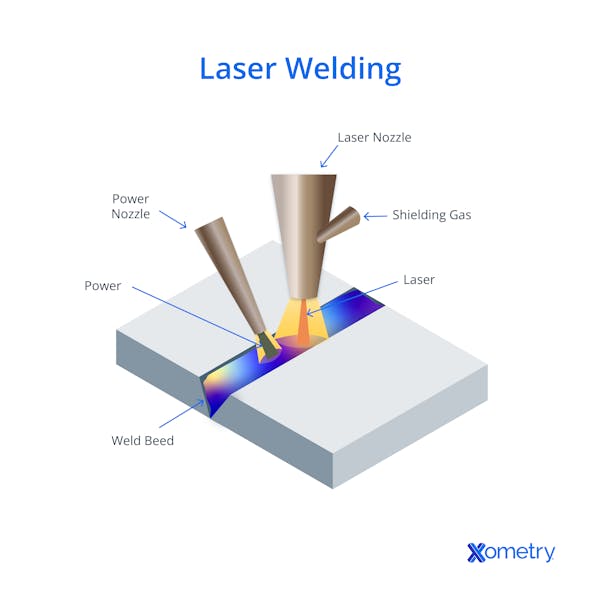
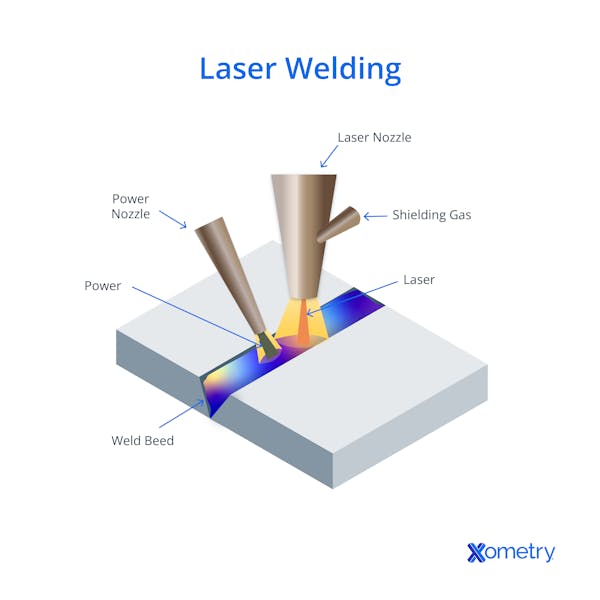
Laser welding machines are becoming increasingly profitable due to rising demand for precision manufacturing in automotive, aerospace, and electronics industries. Traditional welding methods like MIG and TIG are labor-intensive and less consistent, driving companies to adopt automated laser solutions. Fiber laser welders offer deep penetration, minimal heat distortion, and high-speed processing, improving throughput and weld quality.
Industrial demand is growing, especially in battery manufacturing and electric vehicle (EV) production, where seam strength and repeatability are critical. Systems equipped with JPT or Raycus fiber laser sources deliver stable beam quality and long service life. The integration of wobble welding heads allows for wider, more uniform weld beads, reducing the need for post-processing.
Compared to traditional methods, laser welding reduces material waste and energy use while increasing automation compatibility. This lowers operational costs over time despite higher initial investment. Return on investment (ROI) is typically achieved within 12–18 months in high-volume production lines.
The table below compares traditional welding methods with modern laser welding:
| Caraterística | Traditional Welding (MIG/TIG) | Laser Welding (Fiber, Wobble) |
|---|---|---|
| Profundidade de penetração | Shallow to moderate, inconsistent | Deep, consistent with precise control |
| Heat-Affected Zone (HAZ) | Large, causes warping and stress | Minimal, preserving material integrity |
| Velocidade | Slow, requires multiple passes | High-speed, single-pass capability |
| Compatibilidade com a automatização | Limited, often manual intervention | Fully automatable with robotic arms |
| Custos operacionais | High consumables, electrode wear | Low maintenance, no consumables |
| Precision & Repeatability | Moderate, operator-dependent | High, CNC-controlled accuracy |
Laser welding’s scalability and clean process align with global trends toward sustainable, high-efficiency manufacturing. As industries prioritize quality and carbon footprint reduction, laser welding systems offer both economic and environmental advantages. This synergy of performance and sustainability ensures strong market growth and profitability for early adopters.
Principais caraterísticas e vantagens
Klear Laser’s superiority stems from premium industrial-grade components engineered for precision and reliability. We exclusively use JPT or Raycus fiber laser sources, delivering exceptional beam quality (M² <1.2) for consistent deep penetration. This ensures strong, defect-free welds even on challenging materials like stainless steel or aluminum. Industry-standard sources often lack this thermal stability and focus.
Our advanced wobble welding heads feature 5-axis control with adjustable frequency (0–500Hz) and amplitude (up to 3mm). This adaptive technology minimizes spatter and ensures smooth, precise seams on complex geometries. Competing fixed-parameter heads struggle with material thickness variations and produce inconsistent results.
Klear systems integrate industrial closed-loop chillers maintaining ±0.5°C temperature stability. This prevents overheating during high-duty cycles, unlike air-cooled alternatives that fail under sustained operation. Continuous production in automotive or aerospace environments is guaranteed without thermal drift.
| Componente | Klear Laser Specification | Standard Industry Spec |
|---|---|---|
| Fonte de laser | JPT/Raycus 1000W (M² <1.2) | Generic 800W (M² >1.8) |
| Frequência de oscilação | 0–500Hz adjustable | Fixed 50Hz |
| Sistema de arrefecimento | 5KW Closed-Loop Chiller | Arrefecido a ar |
| Welding Speed | Up to 10m/min (1mm steel) | Max 6m/min (1mm steel) |
These components collectively deliver unmatched weld quality, efficiency, and durability for demanding industrial applications.
Aplicações industriais
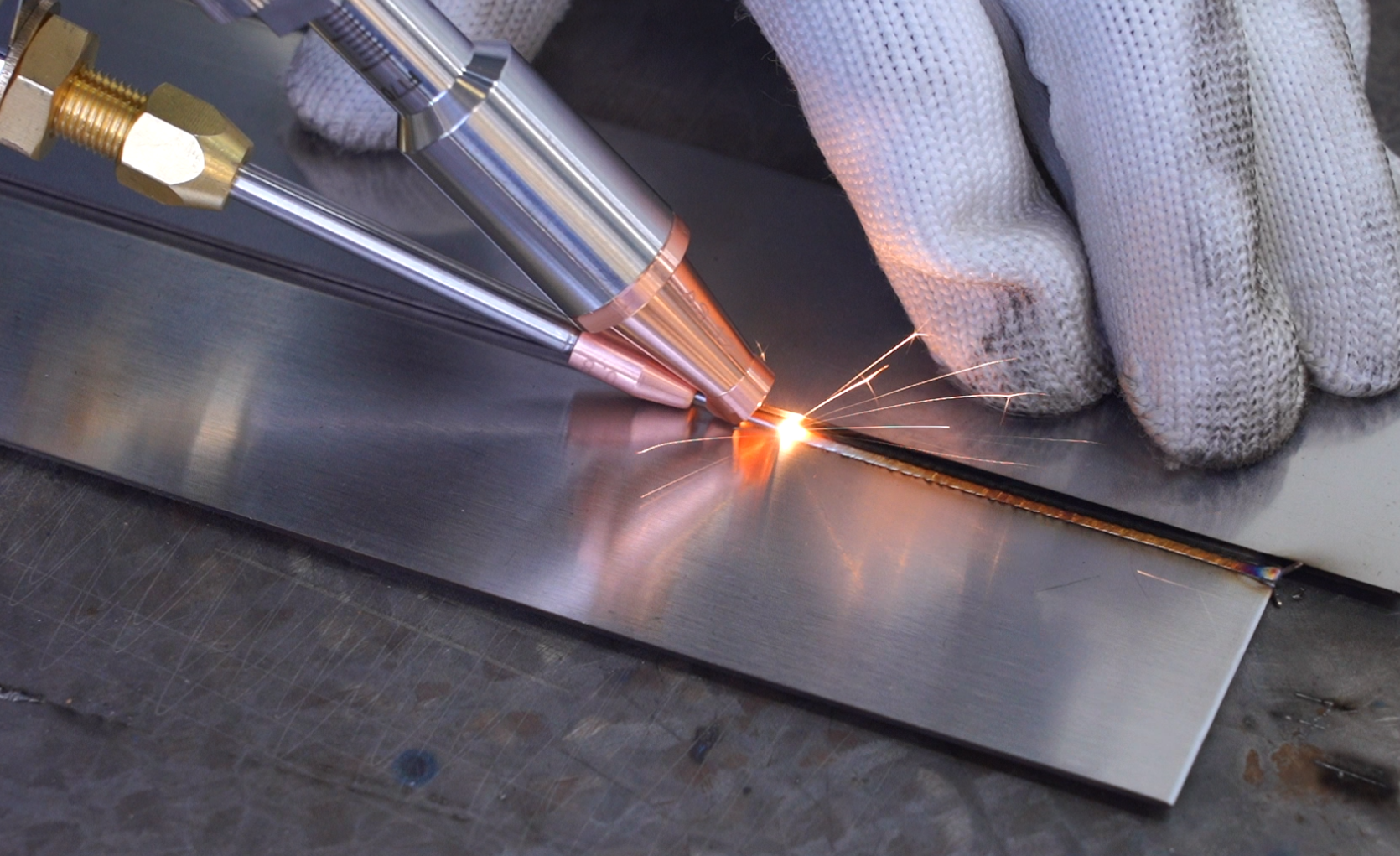
A fiber laser welder works by focusing a high-density beam of 1060–1080 nm light into a spot only 50–100 µm wide. The photons couple almost instantly with the free electrons in steel, aluminum or copper, turning absorbed energy into a keyhole of 6 000–10 000 °C plasma. As the keyhole advances, molten walls flow together behind it and solidify at rates of 1–5 m min⁻¹, giving automotive, aerospace and marine fabricators a weld that is 30 % deeper and 80 % faster than TIG.
In automotive plants the same 2–4 kW JPT or Raycus source jumps from body-in-white fusion lines to battery tab welding without changing optics. A wobble head oscillates the beam 0–3 mm side-to-side at 100–1000 Hz, letting the robot fill 0.3–2 mm gaps on zinc-coated steels without spatter that once clogged EV battery trays. The result is Class-A surface quality at 5 m min⁻¹ and 0.8 mm penetration—perfect for lap joints on 6xxx series extrusions.
Aerospace shops value the 1 µm wavelength because it reflects far less off titanium and nickel super-alloys than CO₂ ever did. With 3–6 kW single-mode power they keyhole 3 mm Inconel turbine rings in a single pass, keeping heat input below 0.5 kJ mm⁻¹ so post-weld heat treatment disappears from the routing. Because laser delivers the wire contact-free, there is no tungsten inclusions to meet NDT Level 3 on AMS 2680.
Marine-grade 5083 and 6082 aluminum lose their oxide instantly under the laser’s first 100 ns, letting a 4 kW source penetrate 5 mm in flat position. A scanner wobble widens the bead to 2 mm, relaxing joint fit-up on curved super-yacht panels while still holding −60 °C Charpy values for DNV approval. Compared with MIG, distortion drops 70 %, so owners save weeks of fairing compound and rework.
| Typical Industry | Key Alloys | Thickness Range | Joint Style | Velocidade de soldadura | Post-Work Saved |
|---|---|---|---|---|---|
| EV Auto Body | low-carbon zinc-coated, 6xxx Al | 0.3–2 mm | lap, fillet | 3–6 m min⁻¹ | grinding, spatter cleaning |
| Aircraft Turbines | Ti-6Al-4V, Inconel 718 | 0.5–3 mm | butt, T-joint | 1–2 m min⁻¹ | re-heat-treatment |
| Luxury Marine | 5083-H321, 6082-T6 | 2–6 mm | butt, corner | 0.8–1.5 m min⁻¹ | fairing, distortion re-work |
Porquê escolher a Klear Laser
Klear Laser recognizes that in an industrial environment, equipment reliability is paramount to maintaining consistent throughput. Our technical support team is composed of engineers well-versed in the specific modulation frequencies and duty cycles required for optimal laser welding. We provide direct assistance to troubleshoot parameter settings, ensuring you achieve deep penetration and structurally sound welds on difficult materials like aluminum or copper.
Our warranty structure is designed to mitigate risk when adopting advanced fiber laser technology for heavy-duty applications. We partner with industry leaders like JPT and Raycus to ensure the laser source, the heart of the machine, is covered against premature failure or power degradation. This coverage guarantees that the beam quality remains consistent over the machine’s lifespan, maintaining the precise spot size necessary for high-quality joinery.
Access to spare parts is streamlined to prevent bottlenecks in your supply chain during critical production runs. We maintain a robust inventory of consumables, specifically protective windows and copper welding nozzles, which are subject to normal thermal wear during operation. Quick shipping protocols are in place to ensure that these essential components reach your facility before maintenance intervals disrupt your workflow.
Component Lifespan and Coverage Overview
| Categoria de componentes | Primary Function | Estimated Service Life | Cobertura da garantia |
|---|---|---|---|
| Fiber Laser Source | Generates the laser beam (JPT/Raycus) | 100,000+ Hours (MTBF) | 2-Year Comprehensive |
| Wobble Welding Head | Controls beam oscillation and focus | 5-10 Years | 1-Year Mechanical |
| Lentes de proteção | Shields optics from spatter/fumes | 1-4 Weeks (Usage Dependent) | Consumable (No Warranty) |
| Copper Nozzle | Directs shielding gas and defines tip distance | 1-3 Months | Consumable (No Warranty) |
| Chiller Unit | Maintains thermal stability for the source | 5-7 Years | 1-Year Standard |
💰 ROI Calculator: How Does A Laser Welder Work
Pronto para atualizar a sua produção?
Contacte a Klear Laser para obter soluções industriais profissionais.