When selecting weld laser, always prioritize the laser source brand (JPT/Raycus) over raw wattage for long-term reliability.
Weld Laser: Technical Specifications
Fiber laser welding locks the photon into 1070 nm ±10 nm, a wavelength that steel, stainless, Inconel, and titanium absorb at 35-45 %—roughly eight times better than the 10 % uptake of 10.6 µm CO₂ light. That fundamental match means the same kilowatt now drives heat deeper and faster, so you can run autogenous keyhole welds at 1-6 m min⁻¹ without filler or edge bevel preparation. Because the 1070 nm beam exits a 25-50 µm fiber core, the focused spot size shrinks to 30-60 µm; energy density rockets past 1 MW cm⁻², collapsing material into a vapor cavity that yields 0.2-8 mm penetration in a single pass. The wavelength also couples well through a wobble head; rapid 0-4 kHz beam oscillation widens the melt pool without diluting depth, eliminating porosity that plagued old Nd:YAG welds.
Pulse energy in continuous-wave fiber welders is not a “one-shot” spec; instead we shape quasi-pulse packets by gating the 1-4 kW CW source with micro-second rise/fall. Peak power can therefore scale 2-3× average, giving controlled spatter ignition at arc start and crater fill at ramp-off. For thin foils we drop to 50-200 W average, yet the 5 kW peak micro-pulse still punctures oxide so the weld wets; thick ship plate reverses the ratio—3 kW average, 3.2 kW peak—to maintain a calm keyhole. Because every packet rides on 1070 nm photons absorbed within 100 nm of the surface, HAZ width collapses to 0.1-0.3 mm and distortion falls below 0.05 mm m⁻¹, letting you weld 0.2 mm bus-bar to 1 mm terminal without warp or blow-through.
Cooling the 30-35 % electro-optics efficiency is the silent enabler. Klear systems pair a 1 °C stability TEC chiller to a 0.1 MPa micro-channel cold-plate under the JPT or Raycus module; coolant never contacts optics, eliminating lens fog. Return temperature is held at 22-25 °C so the 1070 nm cavity wavelength drifts <0.5 nm, keeping focal shift under 50 µm across an 8-hour shift. The same chiller loop knocks 200 °C off the beam-delivery QBH, extending fiber life beyond 100 000 hours; compare that to lamp-pumped YAG rods that needed distilled-water swaps every 500 h and still browned optics.
Old MIG and TIG arc processes throw 60-80 % of their energy into radiant heat; part distortion demands post-machining and thick filler wire wastes kilograms of CuSi₃ per seam. The table below stacks those realities against a 2 kW single-mode Klear weld laser.
| Parameter | TIG / MIG (traditional) | Klear 2 kW Fiber Weld Laser |
|---|---|---|
| Heat source wavelength | 0.2-1.4 µm (broad arc) | 1070 nm ±10 nm |
| Energy coupling in steel | ~40 % via plasma | 35-45 % direct |
| Typical penetration @ 1 m min⁻¹ | 2 mm, 3 passes | 4 mm, 1 pass |
| Filler metal required | 0.8-1.2 kg per 10 m | 0 kg autogenous |
| Heat input kJ mm⁻¹ | 0.8-1.5 | 0.2-0.4 |
| HAZ width | 2-4 mm | 0.1-0.3 mm |
| Distortion (1 m stainless) | 0.5-1 mm | <0.05 mm |
| Post-weld cleaning | Grinding, acid pickling | None |
| Cooling medium | Ambient + water interpass | Closed-loop 22 °C chiller |
| Arc starts per metre | 3 | 1 continuous keyhole |
| Energy cost per 10 m, 4 mm SS | 6.5 kWh | 1.1 kWh |
Switching to the 1070 nm fiber platform therefore cuts kilograms of consumables, erases secondary machining, and delivers x-ray clean ferritic seams at production line speed—while the chiller quietly guards beam quality for a decade of trouble-free shifts.
Key Features & Advantages
At Klear Laser, the superiority of our fiber laser welding machines stems directly from our refusal to compromise on core optical components. We exclusively integrate premium JPT and Raycus laser sources, which are the industry benchmarks for beam quality and power stability. These sources provide a high-brightness beam that ensures deep penetration welds and consistent energy delivery, even during continuous 24/7 industrial operation.
The second critical factor in our technical advantage is the implementation of advanced wobble welding heads. Unlike fixed-beam systems, our wobble heads oscillate the laser beam at high frequencies to create a wider weld seam and bridge larger gaps between workpieces. This dynamic beam manipulation significantly reduces the requirement for perfect part fit-up and minimizes the heat-affected zone to prevent material distortion.
Our systems are engineered to replace slow, skill-intensive processes like TIG welding by offering speeds up to four times faster with superior aesthetic results. The combination of a high-stability source and a precision wobble head allows operators to weld dissimilar metals and thin-gauge sheets without burn-through. This results in a structurally sound joint that requires little to no post-weld grinding or polishing.
| Technical Specification | Klear Laser Configuration | Generic Entry-Level Laser | Traditional TIG Welding |
|---|---|---|---|
| Laser Source Brand | JPT / Raycus (High Stability) | MAX / Generic Brands | N/A |
| Beam Delivery System | Dual-Axis Wobble Head | Fixed or Single-Axis Head | Tungsten Electrode |
| Penetration (3kW Source) | Up to 8.0mm (Stainless Steel) | Up to 5.0mm (Stainless Steel) | Variable (User Dependent) |
| Heat Affected Zone (HAZ) | Micro-localized | Moderate | Large / High Distortion |
| Gap Tolerance | High (Bridge up to 2.0mm) | Low (Requires perfect fit) | Moderate (Requires Filler) |
| Cooling Method | Active Industrial Chiller | Passive or Basic Air | Air Cooled Torch |
Industrial Applications
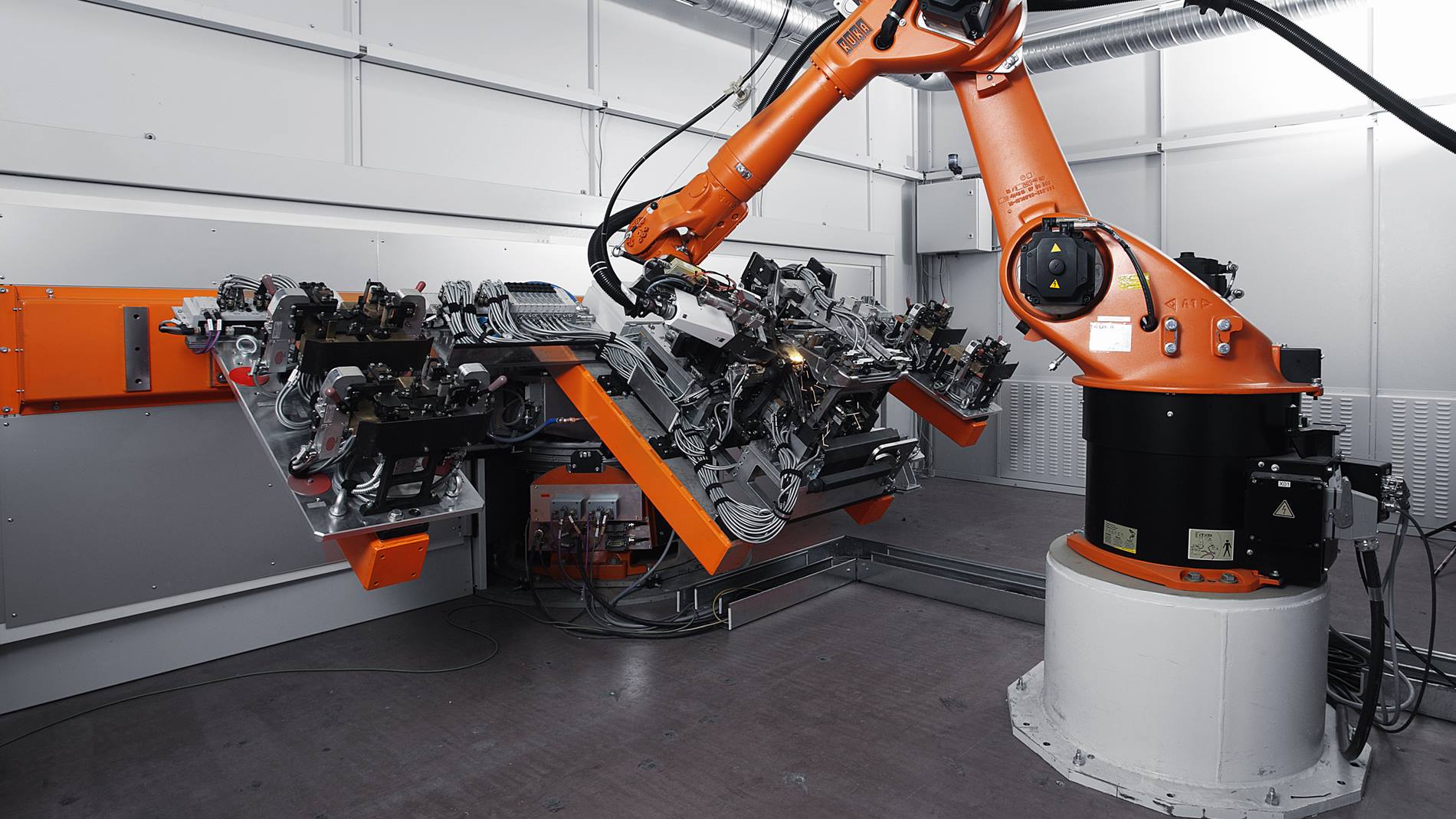
Laser welding excels in automotive manufacturing for precision joining of lightweight components. It enables deep penetration welds on aluminum and high-strength steel battery housings for electric vehicles. Structural chassis parts benefit from minimal heat distortion compared to MIG welding. Hermetic sealing of sensor housings and fuel systems relies on consistent laser weld quality.
Aerospace demands extreme weld integrity for safety-critical components. Our fiber lasers with JPT/Raycus sources achieve full penetration in thin-walled titanium hydraulic lines and engine brackets. Wobble welding heads ensure smooth, spatter-free seams on Inconel turbine parts. The process meets stringent NADCAP standards for fatigue resistance in airframe assemblies.
Marine industry applications focus on corrosion-resistant joints for harsh environments. Stainless steel and duplex alloy piping systems are welded with precise heat control to maintain crevice corrosion resistance. Ship superstructures use laser welding for aluminum deck components, reducing weight while ensuring structural integrity. Substrate safety is maintained through optimized pulse shaping to prevent intergranular attack.
The following table outlines key materials and applications across these sectors:
| Material | Typical Thickness Range | Key Industrial Applications |
|---|---|---|
| Aluminum Alloys (6xxx, 5xxx) | 0.5 mm – 6.0 mm | EV battery trays, aircraft fuselage panels, marine superstructures |
| Stainless Steel (304, 316) | 0.3 mm – 8.0 mm | Hydraulic tubing, food processing equipment, ship piping systems |
| Titanium (Grade 5) | 0.4 mm – 5.0 mm | Aerospace actuators, chemical valves, marine heat exchangers |
| High-Strength Steels | 1.0 mm – 10.0 mm | Automotive crumple zones, truck frames, offshore platform fittings |
Our high-brightness fiber lasers deliver consistent 1:1 aspect ratio penetration up to 10mm in steel without filler wire. Wobble head technology actively controls melt pool dynamics for gap-bridging capability in real-world production tolerances. This eliminates secondary finishing steps required by traditional welding methods.
Why Choose Klear Laser
Klear Laser delivers a comprehensive industrial support ecosystem designed to maximize uptime for fiber laser welding operations. Our value proposition centers on three pillars: proactive technical support, robust warranty protection, and strategically managed spare parts logistics. This integrated approach ensures your JPT or Raycus laser sources, wobble welding heads, and chiller systems maintain peak performance under continuous production demands. We understand that every hour of downtime impacts your bottom line.
Our technical support team specializes in fiber laser welding diagnostics and process optimization. We provide remote troubleshooting via secure VPN connectivity to your machine controller, enabling real-time analysis of power delivery, beam quality, and wobble head parameters. For complex issues requiring physical intervention, certified field service engineers deploy within 24-48 hours to diagnose source module failures or align optical chains. Support extends beyond break-fix to include weld penetration optimization and parameter development for new joint configurations.
Standard warranty coverage includes 24 months full protection on JPT and Raycus fiber laser sources, chiller systems, and CNC controllers. This encompasses optical component degradation, electrical subsystem failures, and cooling system malfunctions. Extended warranty options push coverage to 36 or 48 months, inclusive of preventive maintenance visits and discounted spare parts pricing. All warranties guarantee replacement of failed source modules or wobble welding heads with factory-calibrated units, ensuring your welding penetration specifications remain consistent.
Our spare parts inventory focuses on high-wear components critical to welding operations. We maintain North American stock of protective lenses, copper nozzles, ceramic rings, and JPT source modules with same-day shipping capability. Raycus laser source replacements ship within 72 hours from our regional distribution center. Each spare part undergoes metrological verification before shipment, ensuring compatibility with your specific machine configuration and beam delivery specifications.
| Component Category | Typical Lead Time | Stock Location | Compatibility Verification |
|---|---|---|---|
| JPT Source Modules | 24-48 hours | North America | Serial-matched calibration |
| Raycus Laser Sources | 72 hours | Regional DC | Beam parameter testing |
| Wobble Welding Heads | Same day | Local inventory | Dynamic balance check |
| Protective Optics | Same day | Local inventory | Coating spec verification |
| Chiller Components | 48 hours | Regional DC | Capacity-matched |
💰 ROI Calculator: Weld Laser
Ready to Upgrade Your Production?
Contact Klear Laser for professional industrial solutions.