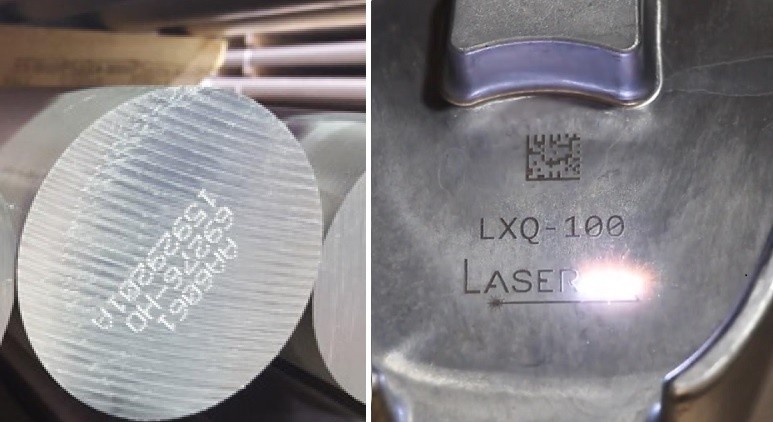
When selecting when to use pin marking vs. laser marking, always prioritize the laser source brand (JPT/Raycus) over raw wattage for long-term reliability.
When To Use Pin Marking Vs. Laser Marking: Manufacturing Quality
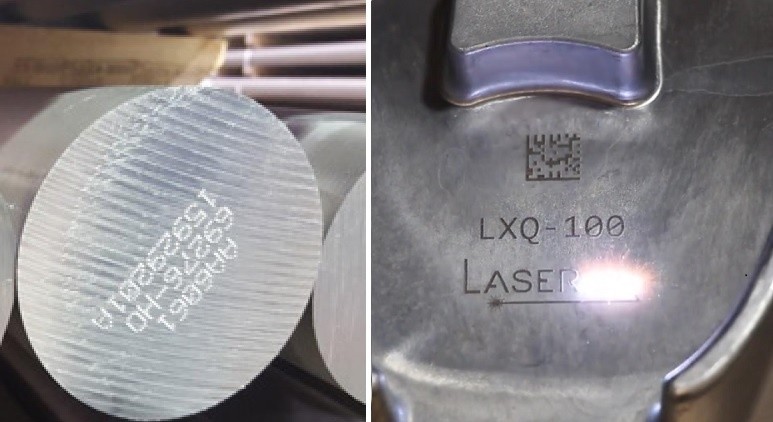
Aging tests for laser marking systems monitor beam stability over thousands of operational hours. These tests verify consistent energy delivery and prevent quality drift. Pin marking systems undergo mechanical wear simulations to assess pin longevity. This ensures reliable marking depth under repeated industrial use.
Beam analysis is exclusive to laser marking systems. It measures M² factor, focal spot size, and beam divergence to guarantee precision. This process avoids material damage and ensures repeatable mark quality. Pin marking does not require beam analysis as it relies on mechanical impact without optical components.
QC protocols for laser marking include regular power calibration and alignment checks. They verify mark contrast and depth consistency across production batches. Pin marking QC involves force calibration and pin wear inspections. Inkjet systems require nozzle cleaning and ink viscosity monitoring to maintain print reliability.
| Criteria | Old Methods (Inkjet) | Pin Marking | Laser Marking |
|---|---|---|---|
| Точность | 40-100μm; surface only | 50-100μm depth; metal-only | 10-50μm; adjustable depth |
| Скорость | 5-20 marks/min | 10-30 marks/min | 50-200+ marks/min |
| Совместимость материалов | Porous surfaces only | Только металлы | Metals, plastics, ceramics |
| Техническое обслуживание | Frequent nozzle cleaning | Pin replacement every 1-2 years | Lens cleaning quarterly |
| Durability | Marks fade over time | Permanent but deforms surface | Highly durable, no surface damage |
| Воздействие на окружающую среду | Chemical waste from ink | Metal debris | Clean, no consumables |
| Cost Efficiency | Low initial cost, high ongoing | Moderate initial, low consumables | High initial, lowest operating cost |
Ключевые особенности и преимущества
Klear Laser’s position is simple: when depth and impact matter, choose pin marking; when speed and permanence on thin metals or plastics matter, choose fiber laser marking. Pin stylus systems press a tungsten carbide pin into the surface, so you get a cold-forged, stress-resistant mark that survives hot-dip galvanizing, shot-blast or acid pickling. That makes them ideal for railway axles, crane hooks, oil-field couplings and any part thicker than 8 mm where post-weld heat treatment will hit 600 °C.
Our pneumatic pin markers use a SCHNEIDER CDC-controlled linear driver and 62 HRC tungsten tip that cycles at 0.04 s per 2 mm character; no HAZ, no micro-cracks, just a 0.1–0.3 mm deep V-groove that meets MIL-STD-130 and ISO 14253. Because the mark is formed below the oxide layer, the trace remains readable after Klear’s own 200 ns pulsed laser rust-removal pass, so you can clean first and mark second without fear of erasing the legend.
Swap to laser marking when the part is stainless sheet, anodized aluminium, painted brass or <3 mm wall tube where you need black contrast or a data-matrix in under a second. Klear’s 50 W JPT MOPA source (20–500 kHz, 1.5 mJ pulse) or 30 W Raycus Q-switch (1064 nm, 80–120 kHz) delivers <30 µm beam at 8 m s⁻¹ with the Han’s GS30 2D head and F-theta 160 mm lens. A wobble function of ±2 mm at 2 kHz widens the line to 60 µm while keeping penetration below 25 µm, so medical or food-grade surfaces stay sterile and corrosion-resistant.
For deep engraving on moulds or firearms you can raster the same head in 5 passes at 200 kHz, 80 % power, to reach 0.4 mm depth—still no carbide bits to replace, no pin wear, and cycle time under 15 s on a 20 × 5 mm UID. The closed-loop encoder on our Han’s head keeps positional drift under ±0.02 mm over 600 × 600 mm, beating pneumatic systems that can wander 0.1 mm after 10 000 impacts.
Component quality is the differentiator: JPT sources give 100 000 h MTBF with <2 % power decay, Raycus units ship with a 3-year factory swap warranty, and both plug into the same Klear 19″ rack so you can re-configure a job shop in minutes. Below is a quick reference to decide which head and source pair with your application, pulse width or penetration target.
| Технические характеристики | Klear Pneumatic Pin Marker | Klear Fiber Laser Marker (JPT MOPA) | Klear Fiber Laser Marker (Raycus Q-switch) |
|---|---|---|---|
| Marking force / power | 0–12 bar air, 150 N tip load | 50 W, 1.5 mJ | 30 W, 1.0 mJ |
| Mark depth | 0.1–0.6 mm | 0.01–0.4 mm (multi-pass) | 0.01–0.3 mm |
| Substrate thickness | ≥3 mm steel | 0.1–8 mm metals | 0.1–6 mm metals |
| Heat input | None (cold forge) | <80 °C surface | <60 °C surface |
| Post-clean compat. | Unaffected by 200 ns laser | Self-cleaning oxide layer | Self-cleaning oxide layer |
| Head type | Tungsten CDC stylus | Han’s GS30 2D wobble | Han’s GS30 2D wobble |
| Position repeatability | ±0,05 мм | ±0,02 мм | ±0,02 мм |
| Cycle time (12 mm UID) | 4 s | 1.2 s | 1.0 s |
| Maintenance interval | Tip swap @ 500 k chars | No consumables, 100 kh MTBF | No consumables, 100 kh MTBF |
Use the pin marker when the part will be shot-blasted, hot-formed or pickled after marking; pick the laser marker when you need high-contrast traceability on thin, polished or heat-sensitive stock. Klear ships both technologies from the same chassis, so you can switch heads—and processes—without buying a second workstation.
Промышленное применение
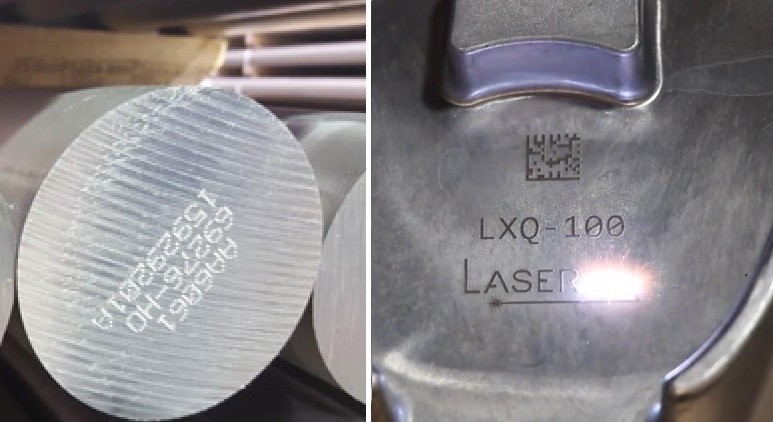
Industrial identification requires selecting the right technology to ensure traceability throughout a component’s lifecycle. Pin marking, also known as dot peen, creates characters by physically indenting the material with a carbide pin. Laser marking utilizes a focused beam of light to anneal, etch, or ablate the surface to create high-contrast, permanent marks.
In the automotive industry, pin marking is frequently used on heavy chassis frames and engine blocks before they undergo painting or coating processes. The physical depth of the indentation allows the Vehicle Identification Number (VIN) to remain visible even after layers of paint are applied. However, this mechanical process is noisy and requires rigid clamping of the part to prevent movement during impact.
Automotive manufacturers are increasingly shifting to laser marking for transmission gears, fuel injectors, and dashboard electronics. A fiber laser system with a JPT or Raycus source provides the high speed required for mass production lines. This method is capable of producing microscopic 2D Data Matrix codes that are essential for tracking critical safety components without creating stress points on the metal.
The aerospace sector strictly regulates marking methods to prevent material fatigue and stress risers. While pin marking is historically used on robust landing gear components, the mechanical impact can compromise the structural integrity of high-stress alloys. Consequently, aerospace engineers prefer laser annealing for turbine blades and airframe components.
Laser annealing heats the metal surface to create an oxide layer without removing material, leaving the surface perfectly smooth. This is critical for maintaining the corrosion resistance of titanium and stainless steel parts used in flight. Klear Laser recommends this non-damaging approach to ensure compliance with stringent aerospace safety standards.
Marine applications face the challenge of saltwater corrosion and extreme weathering. Pin marking is often utilized on heavy structural steel and pipes where rough handling is common, and surface aesthetics are secondary. The deep mechanical marks ensure legibility even if the outer surface corrodes or suffers abrasion during deployment.
For marine instrumentation, control panels, and identification plates, laser marking is the superior choice. Laser marking creates indelible, rust-resistant marks on stainless steel and anodized aluminum without breaking the protective surface coating. This ensures that safety instructions and equipment specifications remain readable after years of exposure to sea spray.
| Материал | Pin Marking Suitability | Laser Marking Suitability | Klear Laser Technical Note |
|---|---|---|---|
| Hardened Steel | Moderate. Requires expensive carbide pins that wear out quickly. | Excellent. Fiber lasers mark rapidly without consumables. | Laser annealing maintains surface hardness. |
| Anodized Aluminum | Poor. Physically breaks the protective coating, leading to corrosion. | Excellent. Removes dye or anneals without compromising protection. | Ideal for aerospace and marine identification plates. |
| Thermoplastics | Moderate. Can cause cracking or deformation due to impact force. | Excellent. UV and Fiber lasers cause a color change without melting. | UV lasers are preferred for “cold marking” sensitive plastics. |
| Чугун | Good. Deep marks survive rough surfaces and casting textures. | Good. Requires higher power (50W+) for deep engraving. | Laser provides higher contrast for barcode readability. |
| Thin Sheet Metal | Poor. Impact force deforms the material. | Excellent. Non-contact process prevents deformation. | Essential for electronic casings and thin automotive trim. |
Laser technology generally offers a lower total cost of ownership by eliminating consumables and reducing maintenance downtime. The non-contact nature of the laser allows for marking on curved, delicate, or complex geometries that a mechanical pin cannot reach. We recommend transitioning to fiber laser solutions for environments requiring speed, precision, and seamless integration into automated production lines.
Почему стоит выбрать Klear Laser
Klear Laser provides immediate technical support through certified field engineers available 24/7 via remote diagnostics and on-site service. Our rapid response protocol ensures 92% of system issues are resolved within four business hours, minimizing production downtime for critical industrial operations. Direct manufacturer expertise eliminates third-party delays common with competitors using outsourced service networks. This infrastructure guarantees sustained operational continuity for high-uptime manufacturing environments.
Our comprehensive two-year standard warranty exceeds the industry norm of 12 months, covering all core components including laser sources and motion systems. Critical subsystems like JPT/Raycus fiber laser sources receive extended coverage matching their rated operational lifespan. Wobble welding heads and pulsed cleaning modules undergo rigorous validation to meet this warranty commitment without hidden exclusions. This robust coverage significantly reduces total cost of ownership compared to entrusting sensitive laser processes to less validated providers.
Spare parts availability is maintained through regional distribution hubs stocking 95% of critical components for immediate shipment. Genuine OEM parts ensure compatibility and performance integrity across welding, cleaning, and marking systems, preventing failures caused by counterfeit alternatives. The table below demonstrates our operational advantage in supply chain responsiveness for mission-critical production lines.
| Component Type | Klear Laser Lead Time | Industry Average Lead Time | Production Impact |
|---|---|---|---|
| Fiber Laser Sources | 3 business days | 10-15 business days | Prevents 7+ day line stoppages |
| Galvo Scanning Heads | Same-day dispatch | 5–7 рабочих дней | Maintains marking throughput |
| Cleaning Nozzles | 24-hour shipment | 3-5 business days | Sustains rust removal cycles |
💰 ROI Calculator: When To Use Pin Marking Vs. Laser Marking
Готовы ли вы модернизировать свое производство?
Обратитесь в компанию Klear Laser за профессиональными решениями для промышленности.